Why Segmentation Matters
Undifferentiated email blasts reduce revenue by 31% compared to segmented campaigns, according to the Klaviyo 2025 Email Benchmark Report.
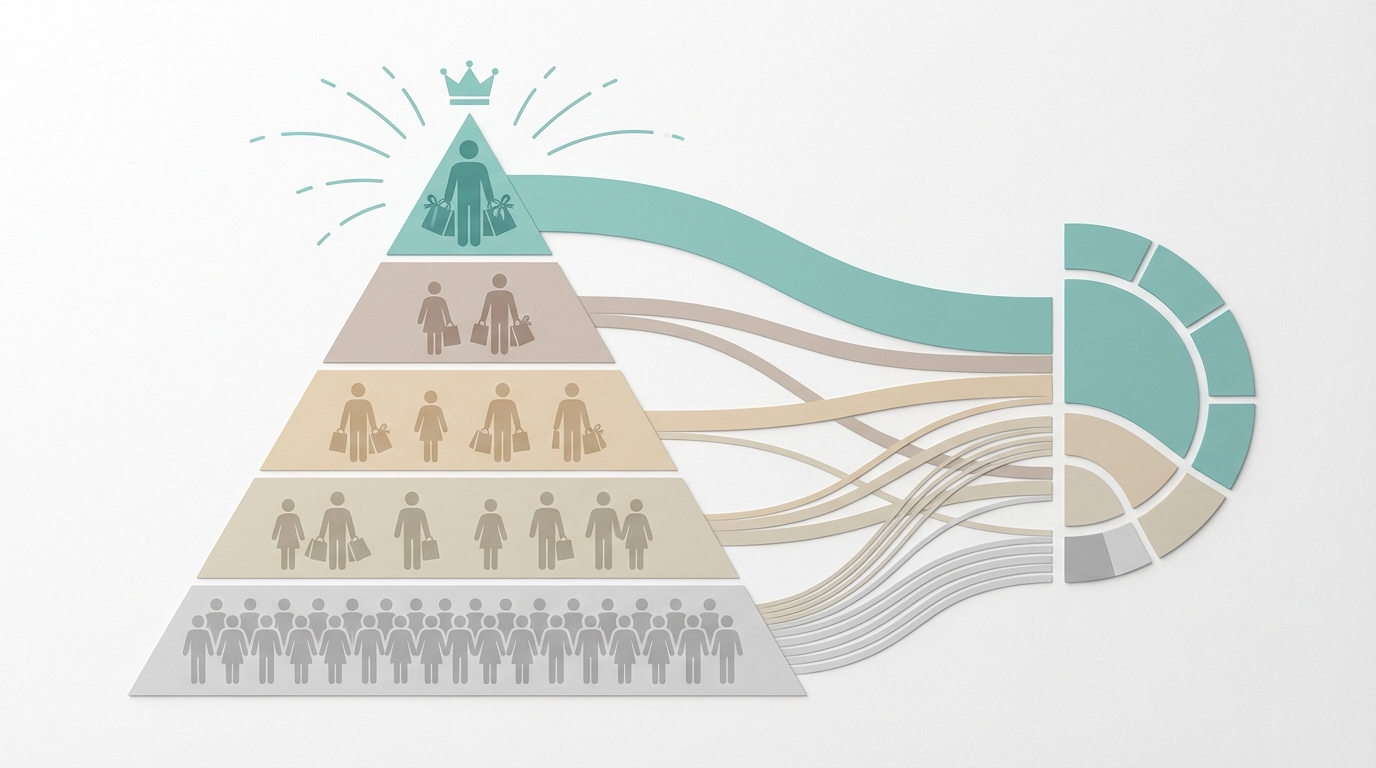 The 5 costs of "blast to everyone":
- Irrelevant messages generate 4x higher ignore rates
- High-value customers receive no differentiated treatment
- Low-value customers consume 40% of marketing budget disproportionately
- Unsubscribes increase by 22% in unsegmented lists
- Revenue per recipient drops below $0.08 per email sent
The 5 measurable segmentation advantages:
- Targeted messaging delivers the right offer to the right customer tier
- Marketing spend efficiency increases by 27% through audience exclusion
- Engagement rates double when content matches purchase history
- Customer experience scores improve across all 4 lifecycle stages
- Revenue per customer increases by 35% within 90 days of segmentation activation
The Segmentation Hierarchy
Level 1: Basic Segments
All 4 foundational segments require zero machine learning to build:
- Purchased vs. non-purchased
- Recent (0–60 days) vs. lapsed (60+ days)
- High-value (top 20% LTV) vs. low-value (bottom 50% LTV)
- Email engaged (opens 30%+) vs. not engaged (opens below 30%)
Level 2: Behavioral Segments
Each of these 4 behavioral segments requires purchase-event data and a minimum of 90 days of history:
- Product category affinity
- Purchase frequency patterns
- Channel preferences
- Discount sensitivity
Level 3: Predictive Segments
Each of these 4 predictive segment types requires an AI/ML layer, such as Klaviyo's predictive analytics engine or Optimove's customer modeling:
- Churn risk scoring
- Next purchase prediction
- Lifetime value prediction
- Propensity scoring
RFM Segmentation
The RFM Framework
 RFM scores 3 purchase dimensions on a 1–5 scale to rank every customer in the database:
R = Recency:
RFM scores 3 purchase dimensions on a 1–5 scale to rank every customer in the database:
R = Recency: Days elapsed since last purchase
F = Frequency: Total number of completed orders
M = Monetary: Cumulative lifetime spend relative to list percentile
Creating RFM Segments
Scoring (1–5 scale):
| Score | Recency | Frequency | Monetary |
|---|
| 5 | <30 days | 10+ orders | Top 20% spend |
| 4 | 30–60 days | 5–9 orders | 60–80% |
| 3 | 60–90 days | 3–4 orders | 40–60% |
| 2 | 90–180 days | 2 orders | 20–40% |
| 1 | 180+ days | 1 order | Bottom 20% |
Key RFM Segments
| Segment | RFM Score | Description | Strategy |
|---|
| Champions | 555, 554, 545 | Best customers | VIP treatment, advocacy |
| Loyal | 444, 445, 454 | Consistent buyers | Loyalty program |
| Potential Loyal | 534, 535, 443 | Recent, growing | Nurture, upsell |
| New Customers | 511, 512, 411 | Recent first purchase | Onboarding, 2nd purchase |
| At Risk | 255, 244, 155 | Was good, gone quiet | Win-back campaign |
| Hibernating | 111, 112, 121 | Long gone | Aggressive win-back or let go |
| Price Sensitive | x3x (any R/M, low F) | Only buys on sale | Targeted promotions |
Behavioral Segmentation
By Purchase Behavior
3 category-affinity segments structure the cross-sell logic for every product recommendation engine, including Yotpo and Klaviyo:
- Single-category buyers
- Cross-category shoppers
- Category switchers
Example strategy:
| Behavior | Segment | Action |
|---|
| Only buys skincare | Skincare loyalist | Cross-sell makeup |
| Bought home + kitchen | Home enthusiast | Full home catalog |
| Switched from A to B | Category explorer | Introduce category C |
By Engagement Behavior
4 email engagement tiers determine send frequency and content type across Klaviyo, Omnisend, and Attentive:
- Highly engaged (opens 80%+)
- Moderately engaged (opens 30–80%)
- Low engagement (opens <30%)
- Inactive (no opens in 90+ days)
Strategy by engagement:
| Segment | Email Frequency | Content Type |
|---|
| High | 4–5x/week | All campaigns |
| Medium | 2–3x/week | Best content |
| Low | 1x/week | Best offers |
| Inactive | Sunset sequence | Win-back |
By Channel Preference
4 conversion-channel identifiers determine where each customer completes purchases, enabling channel-matched retargeting:
- Email buyers
- Social buyers
- Direct/organic buyers
- Paid ad converters
Channel-specific treatment:
| Channel | Preference Treatment |
|---|
| Email | Heavier email cadence |
| Social | Social-first promotions |
| Direct | SEO/content focus |
| Paid | Retargeting priority |
Value-Based Segmentation
Customer Value Tiers
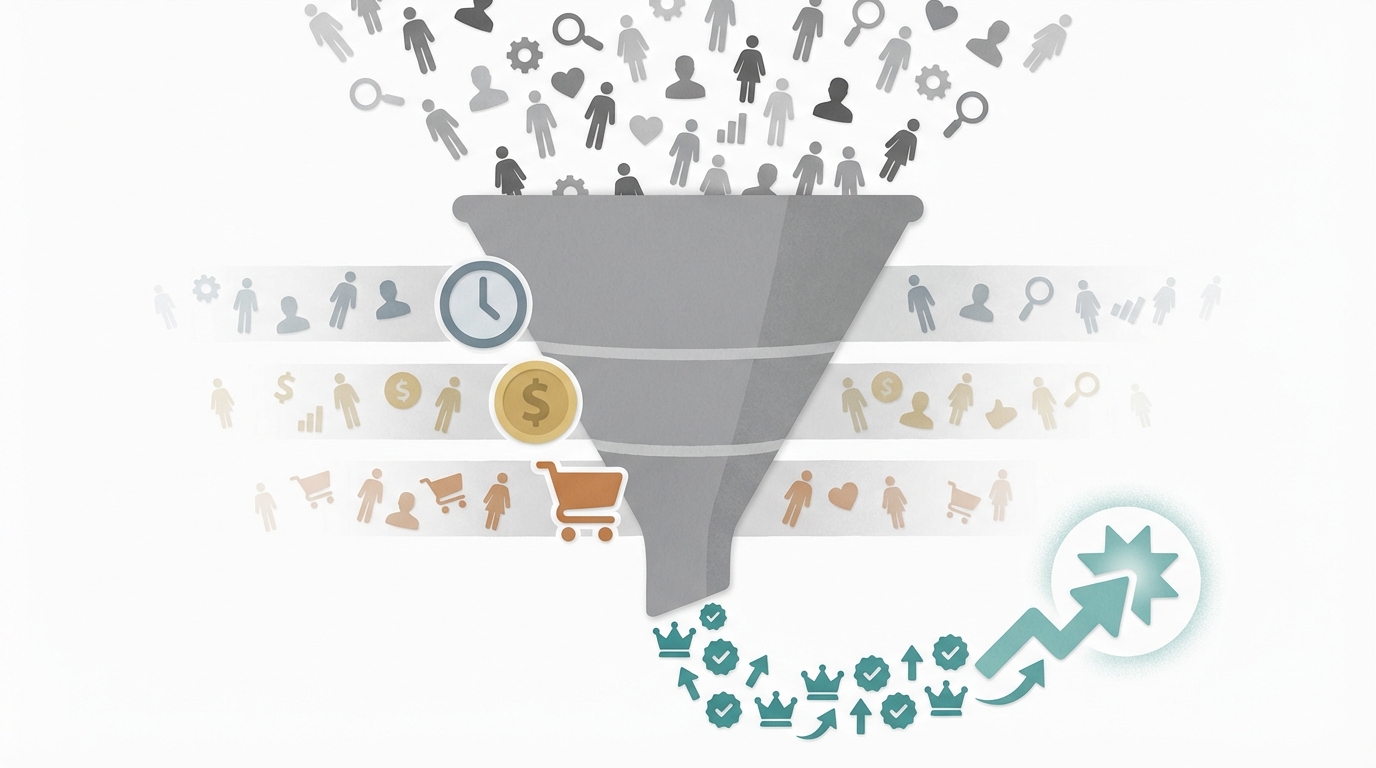 4 LTV tiers concentrate marketing investment on the 10% of customers who generate 45–55% of total revenue:
Top 1%:  VIP          ($X+ lifetime spend)
Top 10%: Gold         (High LTV)
Top 30%: Silver       (Medium LTV)
Bottom 70%: Standard  (Low LTV)
Typical distribution:
| Tier | % of Customers | % of Revenue |
|---|
| VIP | 1% | 15–20% |
| Gold | 9% | 30–35% |
| Silver | 20% | 25–30% |
| Standard | 70% | 15–25% |
Value-Based Treatment
| Tier | Support | Marketing | Perks |
|---|
| VIP | Priority, personal | Exclusive first | Early access, gifts |
| Gold | Fast response | Premium content | Loyalty rewards |
| Silver | Standard+ | Regular campaigns | Occasional perks |
| Standard | Self-service | Batch campaigns | Standard |
Intent-Based Segmentation
Purchase Intent Signals
4 high-intent behaviors trigger immediate cart recovery flows in Klaviyo and Gorgias:
- Added to cart
- Viewed product 3+ times in a single session
- Compared 2+ products side by side
- Checked shipping or returns page
3 medium-intent signals activate product education sequences:
- Browsed a category page for 3+ minutes
- Clicked an email product recommendation
- Spent more than 3 minutes on-site without adding to cart
3 low-intent signals route visitors into top-of-funnel brand awareness flows:
- Viewed homepage only
- Completed a single page view
- Bounced within 15 seconds
Intent-Based Marketing
| Intent Level | Tactic |
|---|
| High | Cart recovery, urgency, discount |
| Medium | Product education, social proof |
| Low | Awareness, brand content |
Lifecycle Segmentation
Customer Lifecycle Stages
Prospect → New Customer → Active → At Risk → Lapsed → Lost
Stage Definitions
| Stage | Definition | Goal |
|---|
| Prospect | Subscribed, not purchased | First purchase |
| New | Purchased <30 days ago | Second purchase |
| Active | Purchased recently, multiple orders | Increase frequency/AOV |
| At Risk | 60–90 days since purchase | Win-back |
| Lapsed | 90–180 days since purchase | Aggressive win-back |
| Lost | 180+ days since purchase | Re-acquisition or release |
Lifecycle Marketing
| Stage | Primary Tactic |
|---|
| Prospect | Welcome series, first purchase incentive |
| New | Post-purchase nurture, review request |
| Active | Loyalty program, cross-sell |
| At Risk | "We miss you," special offer |
| Lapsed | Deep discount, feedback request |
| Lost | Re-acquisition campaign or suppress |
Building Segments
Data Requirements
3 minimum data types activate RFM and lifecycle segmentation inside Klaviyo or Omnisend:
- Purchase history (orders, dates, amounts)
- Email engagement (opens, clicks)
- Basic demographics (location)
4 advanced data types unlock behavioral and predictive segmentation layers:
- Browse behavior (pages and products viewed per session)
- Channel source attribution
- Support interaction history from Gorgias
- Survey response data from post-purchase flows
Implementation Steps
Step 1: Audit your data
- Identify every data field currently collected
- Map where each data type lives (Shopify, Klaviyo, Gorgias, Recharge)
- Score data cleanliness on a 1–5 accuracy scale
Step 2: Start simple
- Build RFM scoring across 5 tiers
- Define 6 lifecycle stages
- Create 3 basic engagement tiers
Step 3: Build segments
- Define entry and exit criteria for each segment
- Create dynamic segments inside Klaviyo or Omnisend
- Test each segment with a 500-contact sample campaign
Step 4: Activate
- Customize 4 core flows by segment (welcome, abandoned cart, post-purchase, win-back)
- Adjust campaign send lists by segment tier
- Personalize content blocks using merge tags and conditional logic
Step 5: Optimize
- Monitor segment-level open rate, conversion rate, and revenue per recipient weekly
- Refine entry criteria based on 30-day performance data
- Add predictive scoring layers after 90 days of baseline data collection
| Tool | Capability |
|---|
| Klaviyo | Built-in RFM, predictive analytics, Shopify-native sync |
| Omnisend | Basic segmentation, SMS + email automation |
| Drip | Behavior-based tagging and scoring |
| Customer.io | Advanced conditional logic and API-triggered segments |
| Optimove | AI-powered churn prediction and LTV modeling |
Segment Activation
Email Flows by Segment
| Flow | Segment Customization |
|---|
| Welcome | Product recommendations by traffic source |
| Abandoned cart | Discount depth by customer value tier |
| Post-purchase | Cross-sell by category affinity |
| Win-back | Message aggressiveness scaled by LTV |
Campaign Targeting
4 audience tiers replace the "send to all" approach and reduce unsubscribes by 22%:
- VIP: Early access 48 hours before general launch
- Engaged (opens 30%+): Full campaign with all content blocks
- Medium engaged (opens 10–30%): Single best-performing version only
- Low engaged (opens <10%): Skip send or deliver a stripped-down plain-text version
Advertising Audiences
3 segment-to-audience tactics reduce paid acquisition cost by 28% per Shopify Partner Report:
- Upload VIP segment as a seed audience for lookalike targeting in Meta Ads
- Exclude recent purchasers (last 30 days) from all prospecting campaigns
- Retarget at-risk customers (60–90 days inactive) with LTV-specific discount messaging
Measuring Segmentation
Segment Health Metrics
| Metric | What It Tells You |
|---|
| Segment size | Is it large enough to activate? |
| Segment revenue % | Does it drive meaningful revenue? |
| Engagement rate | Does it respond to messages? |
| Conversion rate | Does it purchase? |
| Migration rate | Is the segment growing or shrinking month over month? |
- Email open rate
- Click rate
- Conversion rate
- Revenue per recipient
- Unsubscribe rate
Optimization Cycle
- Form a segment hypothesis based on purchase or engagement data
- Build the segment using dynamic filters in Klaviyo or Omnisend
- Test with a targeted campaign to a minimum of 500 contacts
- Measure results across all 5 performance KPIs after 14 days
- Refine segment entry and exit criteria based on conversion delta
- Scale winning segments or suppress underperforming ones after 30 days
Common Segmentation Mistakes
1. Too Many Segments
Problem: Complexity without revenue lift collapses execution capacity
Fix: Start with 5–7 core segments and expand only after each segment ties to a specific automated flow
2. Static Segments
Problem: Segments frozen at creation date deliver stale audience data within 30 days
Fix: Dynamic segments that recalculate on every send using real-time Shopify or Recharge purchase events
3. No Activation
Problem: Segments created inside Klaviyo or Omnisend but never attached to a flow or campaign generate zero revenue lift
Fix: Tie every segment to 1 specific automated tactic before publishing it
4. Ignoring Small Segments
Problem: VIP segments containing fewer than 50 contacts receive no dedicated strategy despite generating 15–20% of total revenue
Fix: Right-size segment tactics — VIP segments below 200 contacts warrant personal outreach, not broadcast campaigns
Next Steps
Segmentation delivers 35% higher revenue per customer when tied directly to automated flows in Klaviyo, Omnisend, or Attentive.
- Book a strategy call to build your segmentation strategy
- Read: AI E-Commerce Analytics
- Learn: Customer Lifetime Value
- Explore: Email Marketing Automation
The top 10% of ecommerce stores reach fewer people with higher precision — segmentation is the system that makes that possible.
Related Frameworks: