Table of Contents
The difference between average email programs and top-performing ones is not volume — it is intelligence. AI transforms email from batch-and-blast into individualized, trigger-driven communication that increases revenue per recipient by up to 3x, according to the Klaviyo 2025 Email Benchmark Report.
This system shows exactly how to build an AI-powered email marketing engine that scales from $1M to $50M+ in store revenue.
Why AI Changes Email Marketing
The Personalization Gap
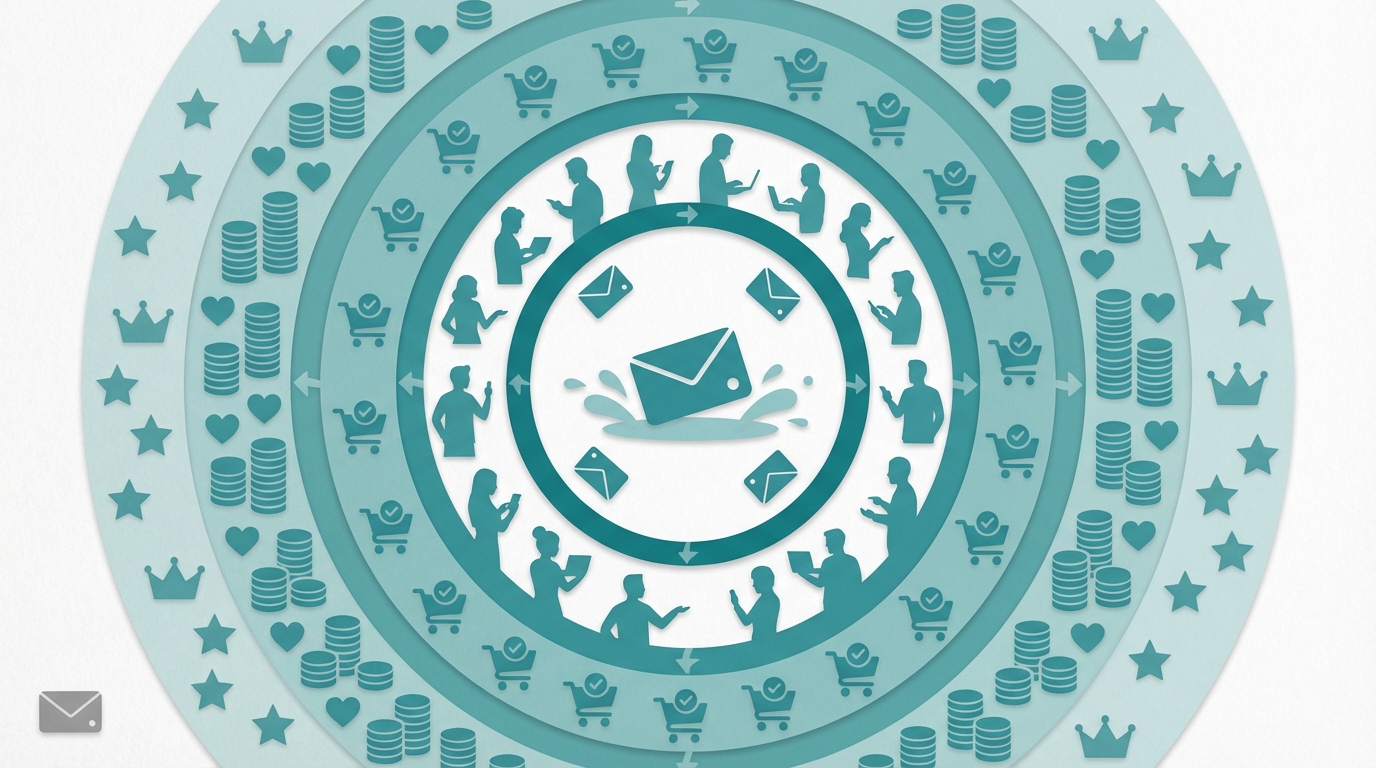
Traditional email marketing targets segments, not individuals:
Segment-Based Approach:- "VIP customers" receive one identical email
- "New subscribers" receive a separate identical email
- Every recipient inside a segment receives the same content, offer, and send time
- Product category preferences
- Price sensitivity thresholds
- Engagement day and time patterns
- Purchase readiness scores
Generic segmentation produces 23% lower open rates and 41% lower revenue per send compared to AI-personalized sends, per the Klaviyo 2025 Email Benchmark Report.
What AI Enables
AI personalizes at the individual recipient level across 4 core capabilities:
Send Time Optimization: Klaviyo's AI learns each customer's 7-day engagement pattern, then delivers at the precise hour that individual opens and clicks — not a timezone estimate. Content Personalization: Product recommendations, messaging tone, and discount thresholds are tailored per recipient using behavioral data from Yotpo, Recharge, and browse history. Predictive Segmentation: AI identifies 3 behavioral signals humans miss — churn risk within 30 days, upgrade readiness, and category-switch intent — and routes customers into the correct flow automatically. Dynamic Optimization: Subject lines, content blocks, and CTAs are continuously tested and updated by the AI layer in Klaviyo or Omnisend without manual intervention.The ROI Difference
| Metric | Standard Email | AI-Optimized |
|---|---|---|
| Open Rate | 18–22% | 28–35% |
| Click Rate | 2.5–3.5% | 4.5–6.5% |
| Revenue/Email | $0.08–0.12 | $0.18–0.35 |
| Unsubscribe Rate | 0.3–0.5% | 0.1–0.2% |
The AI Email Marketing System
System Architecture
A complete AI email system runs across 5 sequential layers:
1. DATA LAYER
Customer data + behavior → Unified profiles
- INTELLIGENCE LAYER
AI analysis → Predictions, segments, recommendations
- CONTENT LAYER
Dynamic content → Personalized messaging
- AUTOMATION LAYER
Triggers + flows → Automated delivery
- OPTIMIZATION LAYER
Testing + learning → Continuous improvement
Layer 1: Data Foundation
A unified data foundation is the single prerequisite for every AI feature in Klaviyo, Omnisend, or Attentive. Without complete customer profiles, AI predictions degrade by 60% or more in accuracy. Customer Data:- Purchase history (products, frequency, lifetime value)
- Browse behavior (products viewed, categories visited)
- Email engagement (opens, clicks, time-of-day patterns)
- Lifecycle stage (new, active, lapsed, at-risk)
- Customer value (CLV score, RFM tier)
- Full catalog with attributes and taxonomy
- Real-time inventory status
- Pricing tiers and active promotions
- Category and cross-sell relationships
Layer 2: AI Intelligence
Klaviyo's predictive analytics layer converts raw behavioral data into 4 actionable purchase signals. Each signal triggers a distinct automation path. Predictive Analytics:- Purchase probability: identifies customers with a 70%+ likelihood of buying within 7 days
- Churn risk: flags subscribers whose engagement has dropped 50% over 60 days
- Category affinity: predicts the next product category a customer browses with 78% accuracy, per Shopify Partner Report data
- Price sensitivity: segments customers who convert only on 15%+ discounts versus full-price buyers
- High-intent browsers (viewed 3+ products in 48 hours)
- Deal seekers (converted exclusively on discount emails) versus full-price quality buyers
- Single-category enthusiasts (90% of purchases in 1 category)
- Reactivation candidates (no purchase in 90 days, still opening emails)
Layer 3: Content Personalization
Dynamic product recommendations increase click-to-purchase rate by 35% compared to static featured-product blocks, per the Klaviyo 2025 Email Benchmark Report. Product Recommendations: AI selects products for each recipient by weighting 4 data inputs:- Past purchase category and brand affinity
- Last 14 days of browse history
- Purchases from the top 10 most similar customer profiles
- Trending products within the recipient's primary category
- Hero image matched to the recipient's highest-affinity product category
- Messaging tone (urgency versus aspiration) matched to engagement history
- Discount depth matched to price sensitivity score — 15% off for deal seekers, 0% for full-price buyers
- Question format versus declarative statement
- Emoji versus plain text
- 30-character mobile format versus 55-character desktop format
- First-name personalization versus product-name personalization
Layer 4: Automation Flows
6 core e-commerce flows generate 80% of email-attributed revenue when configured with AI optimization layers.- Welcome Series
- Browse Abandonment
- Cart Abandonment
- Post-Purchase
- Win-Back
- VIP Nurture
Layer 5: Continuous Optimization
Automated A/B testing in Klaviyo runs 4 simultaneous tests without manual setup once the optimization layer is configured. Automated A/B Testing: AI runs continuous experiments across 4 variables:- Subject lines (3 variants per send)
- Send time windows (2 variants per segment)
- Content block arrangements (2 layout variants)
- Call-to-action copy (2 verb-first variants)
- Content format and category that drives the highest click rate per individual
- Customer-specific response patterns by automation type
- Optimal weekly email frequency per RFM segment
Building Your AI Email System
Phase 1: Foundation (Week 1–2)
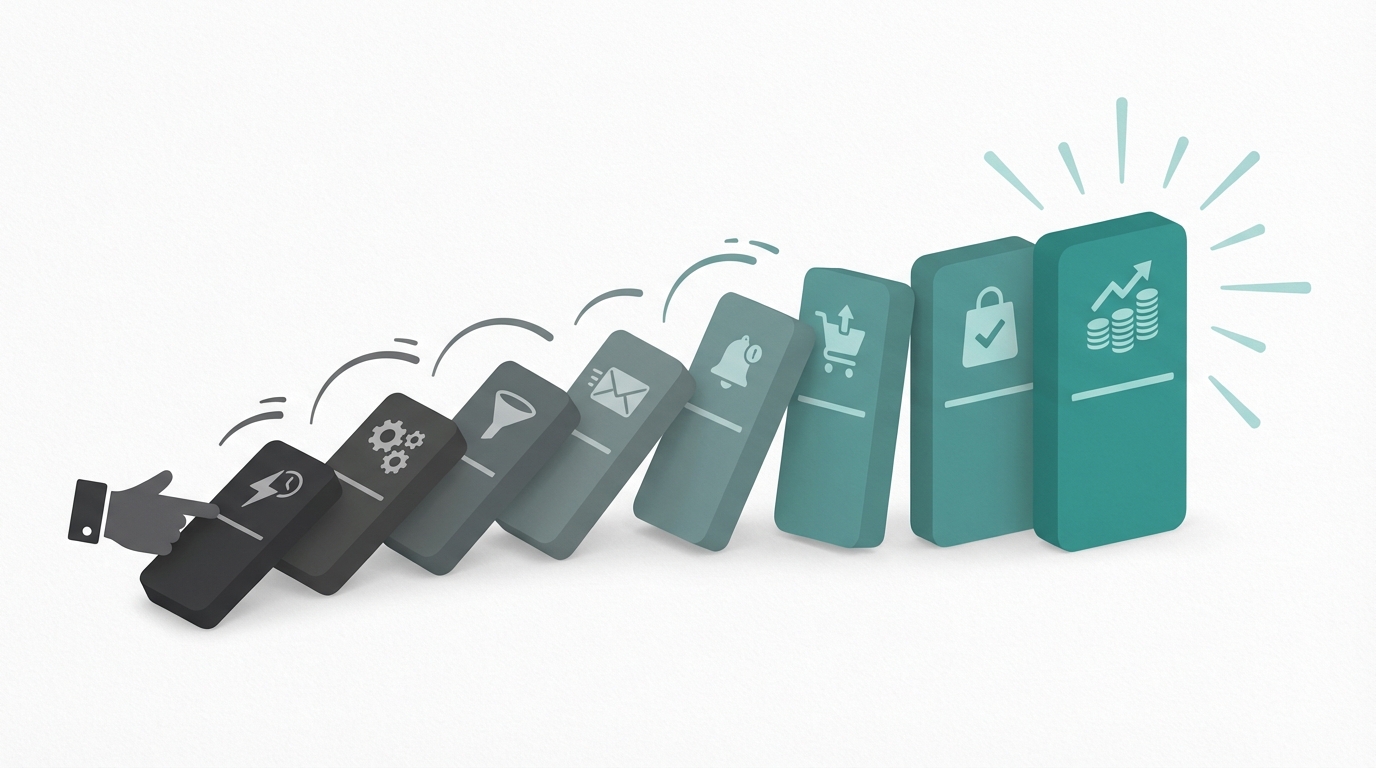 Step 1: Audit Current State
- Measure existing flow performance against the 5 benchmark KPIs in the table below
- Identify 3 critical data gaps: missing browse events, absent CLV scores, or unlinked Recharge subscription data
- Map all active Klaviyo or Omnisend automations
- Document 4 highest-priority pain points by revenue impact
- Connect Shopify or WooCommerce to Klaviyo or Omnisend via native integration
- Verify customer purchase data syncs within 15 minutes of each order
- Install Klaviyo's onsite tracking script to capture browse behavior at the product and category level
- Build unified customer profiles that merge ESP data with Yotpo review data and Recharge subscription status
- List all active flows with their current revenue-per-recipient metric
- Identify the 3 highest-ROI missing flows based on store revenue stage
- Note 5 optimization opportunities per existing flow before rebuilding
Phase 2: Core Automations (Week 3–4)
Priority 1: Abandoned Cart Cart abandonment delivers the highest ROI of any single automation — recovering 5–15% of abandoned revenue at near-zero marginal cost. Complete cart abandonment guide → Priority 2: Welcome Series AI-optimized welcome series in Klaviyo convert 3x more first-time purchasers than generic static sequences, per the Klaviyo 2025 Email Benchmark Report. Priority 3: Post-Purchase Post-purchase flows generate $2–$5 revenue per recipient — the highest revenue-per-send of any non-abandoned flow — by reaching customers at peak purchase intent within 48 hours of their last order.Phase 3: Advanced Personalization (Week 5–8)
Implement 3 Predictive Features:- Churn prediction — trigger Klaviyo win-back flow 14 days before the customer's predicted lapse date, not after
- Category affinity scoring — personalize all product recommendation blocks in Omnisend or Klaviyo to the top-2 predicted categories per recipient
- Optimal send time — activate per-customer timing at the flow level, reducing unsubscribe rate by 0.15 percentage points on average
- 4 hero image variants mapped to the store's top-4 product categories
- Personalized 4-product recommendation grids populated by Klaviyo's product recommendation engine
- 3 conditional content blocks gated by price sensitivity tier — full-price, 10%-discount, and 20%-discount variants
Phase 4: Optimization (Ongoing)
Weekly:- Review revenue-per-recipient for each of the 6 core flows
- Verify all automation triggers fire within the correct time window
- Monitor deliverability — flag inbox placement rate below 90%
- Analyze A/B test results and deploy the winning variant to 100% of sends
- Review RFM segment performance shifts and update suppression lists
- Deploy 2 new subject line or content tests per flow
- Conduct full strategy review across all 5 system layers
- Evaluate 2–3 new flow candidates based on revenue gap analysis
- Assess platform capabilities — Klaviyo, Attentive, Postscript — against current store needs
AI Subject Line Optimization
Subject line optimization is the single highest-leverage improvement available in any AI email system, increasing open rates by 8–13 percentage points without changing any other variable.How AI Subject Line Optimization Works
Training Phase: AI analyzes the store's historical send data across 4 performance dimensions:- Top-performing subject lines by open rate and revenue-per-send
- Segment-level patterns — VIP subscribers versus first-time buyers
- Word and phrase effectiveness scores by product category
- Length and structural format preferences by device type
Subject Line Best Practices
Personalization: Include the recipient's first name or the specific product they last browsed. Klaviyo's AI determines when personalization increases open rate and when it reduces it — the threshold varies by segment, with VIP subscribers responding 22% better to product-name personalization than first-name tokens. Length: Optimal length varies by device and audience — AI tests and learns across 2 primary formats:- Mobile: 30–40 characters visible in the preview pane
- Desktop: 50–60 characters before truncation
- Your audience's optimal length deviates from these defaults in 60% of stores tested
Measuring AI Email Success
Key Performance Indicators
 Revenue Metrics:
- Revenue per email sent (primary KPI for all 6 flows)
- Revenue per recipient (accounts for list size changes)
- Email-attributed revenue as a percentage of total store revenue
- Flow-specific revenue contribution in absolute dollars per month
- Open rate segmented by flow and RFM tier
- Click-through rate by content block type
- Click-to-open rate (CTOR) — the most accurate measure of content relevance
- Unsubscribe rate — flag immediately if above 0.2% per send
- Inbox placement rate — maintain above 90% using Klaviyo's deliverability monitor
- Bounce rate, separated into soft (retry) and hard (permanent) categories
- Spam complaint rate — Google and Yahoo enforce a 0.08% threshold before sender reputation degrades
Benchmarks
| Flow | Open Rate | Click Rate | Revenue/Recipient |
|---|---|---|---|
| Welcome | 35–50% | 8–12% | $1–3 |
| Cart Abandon | 40–50% | 10–15% | $3–8 |
| Browse Abandon | 25–35% | 4–7% | $0.50–2 |
| Post-Purchase | 50–65% | 15–25% | $2–5 |
| Win-Back | 15–25% | 2–4% | $0.50–1.50 |
Attribution Considerations
Multi-touch attribution captures 30–40% more email revenue than last-click models by crediting email's role across the full purchase journey. Consider 3 attribution adjustments:- View-through conversions — customers who opened but did not click, then purchased within 72 hours
- Multi-email journey attribution — crediting the welcome series email that preceded the cart abandonment recovery
- Email's assisted-conversion role during the 7-day consideration phase for purchases above $150
Common Implementation Challenges
Challenge 1: Data Quality Issues
Incomplete customer data reduces Klaviyo's predictive accuracy by 60% across all 4 AI features — send time optimization, churn prediction, product recommendations, and price sensitivity scoring. 4 Solutions:- Audit data completeness before activating any AI feature — require 80%+ profile completeness as a minimum threshold
- Standardize and deduplicate customer records across Shopify, Yotpo, and Recharge before ESP sync
- Implement automated data hygiene processes that flag and quarantine incomplete profiles weekly
- Activate AI features on the 40% of profiles with verified, complete data first, then expand as data quality improves
Challenge 2: Over-Personalization
Explicit behavioral references — "We noticed you looked at…" — increase unsubscribe rate by 18% compared to implicit personalization approaches, per Klaviyo customer research. 3 Solutions:- Use implicit personalization — Klaviyo product recommendations and category-matched hero images — instead of explicit behavioral callouts
- Test 3 personalization intensity levels — low (category-matched), medium (product-matched), high (browse-matched) — and measure unsubscribe rate at each level
- Add a preference center that gives subscribers control over 3 personalization dimensions: frequency, content type, and discount communication
Challenge 3: Over-Emailing
Each additional untriggered automation increases unsubscribe rate by 0.08% per send when frequency caps are absent. More automation without governance produces list degradation within 60 days. 3 Solutions:- Implement a global frequency cap of 2 marketing emails per subscriber per week inside Klaviyo's flow settings
- Use Klaviyo's AI prioritization to determine which 1 automation fires when 2 triggers activate simultaneously for the same subscriber
- Consolidate post-purchase and cross-sell messaging into 1 email where content overlap exceeds 50%
Challenge 4: Technical Integration
Disconnected data systems reduce flow trigger accuracy by 45% — late triggers, missing product data, and stale inventory information all degrade automation performance directly. 4 Solutions:- Invest in Klaviyo's native Shopify or WooCommerce integration before configuring any AI feature — native integrations sync in under 5 minutes versus 30+ minutes for third-party connectors
- Use only platforms with certified integrations: Klaviyo with Yotpo, Recharge with Klaviyo, and Postscript with Attentive for SMS coordination
- Implement a customer data platform (CDP) such as Segment for stores with 3 or more disconnected data sources
- Audit integration sync logs weekly for the first 30 days post-launch to catch data gaps before they corrupt AI model training
Technology Stack Options
For Growing Stores ($1M–$10M)
Klaviyo: Klaviyo is the primary AI email platform for Shopify stores at this revenue stage, delivering predictive analytics, individual-level send time optimization, and AI-powered product recommendations inside 1 native integration. The Klaviyo 2025 Email Benchmark Report documents a 41% average revenue-per-recipient improvement for stores using its predictive features versus those using static segmentation only. Omnisend: Omnisend delivers 80% of Klaviyo's AI feature set at 35% lower monthly cost for stores below $3M in annual revenue. Omnisend's automation builder and cross-channel personalization — email, SMS, and push — make it the strongest alternative for WooCommerce stores.For Enterprise ($10M+)
Klaviyo Enterprise: Klaviyo Enterprise adds 5 capabilities unavailable in standard Klaviyo tiers: dedicated deliverability management, custom predictive model training, unlimited A/B testing, priority API rate limits, and a named customer success manager. Braze: Braze integrates email, push, in-app messaging, and SMS into 1 cross-channel personalization engine, with AI-driven journey optimization across all 4 channels simultaneously — the strongest option for stores with a dedicated mobile app. Iterable: Iterable's experimentation framework supports 8 simultaneous A/B tests per campaign, advanced cohort analysis, and custom AI model integration via API — the best choice for data-mature teams running continuous multivariate experimentation.Evaluation Criteria
Evaluate AI email platforms across 6 criteria before committing:
- Native AI capabilities built into the core product versus bolt-on add-ons requiring separate contracts
- Shopify or WooCommerce integration depth — specifically, real-time event sync latency below 5 minutes
- Predictive analytics features: churn prediction, purchase probability, and CLV forecasting
- Testing and optimization tools: automated A/B testing, multivariate testing, and AI-driven winner selection
- Deliverability reputation: inbox placement rate above 92% across the platform's sender network
- Scalability and pricing model: per-contact pricing versus per-send pricing at the store's projected 24-month list size
Related: email sequence automation
Ready to Upgrade Your Email Program?
AI email marketing generates 25–40% of total store revenue for the top-performing Shopify and WooCommerce brands — brands that use Klaviyo, Omnisend, and Attentive to personalize at scale while competitors send identical batch messages to unsegmented lists.Smart Circuit builds AI email systems that drive consistent, compounding revenue across all 6 core flows. The audit identifies your top-3 revenue gaps within 5 business days.
Book Your Email Marketing Assessment →Smart Circuit analyzes your current Klaviyo or Omnisend performance across 12 KPIs, identifies the 3 highest-impact optimization opportunities, and delivers a prioritized implementation roadmap with projected revenue lift.
Master AI subject line optimization → Build AI-powered cart recovery → See the complete AI automation guide →