Table of Contents
These are not window shoppers. They selected products. They intended to buy. Something stopped them.
Abandoned carts represent recoverable revenue, not lost sales. Stores with optimized recovery systems win back 15–25% of abandoned carts. Stores without structured recovery systems recover fewer than 3%.Understanding Cart Abandonment: The $4 Trillion Problem
Cart abandonment destroys more e-commerce revenue than any other single conversion failure, costing the average Shopify store $280,000 in recoverable sales annually (Shopify Partner Report).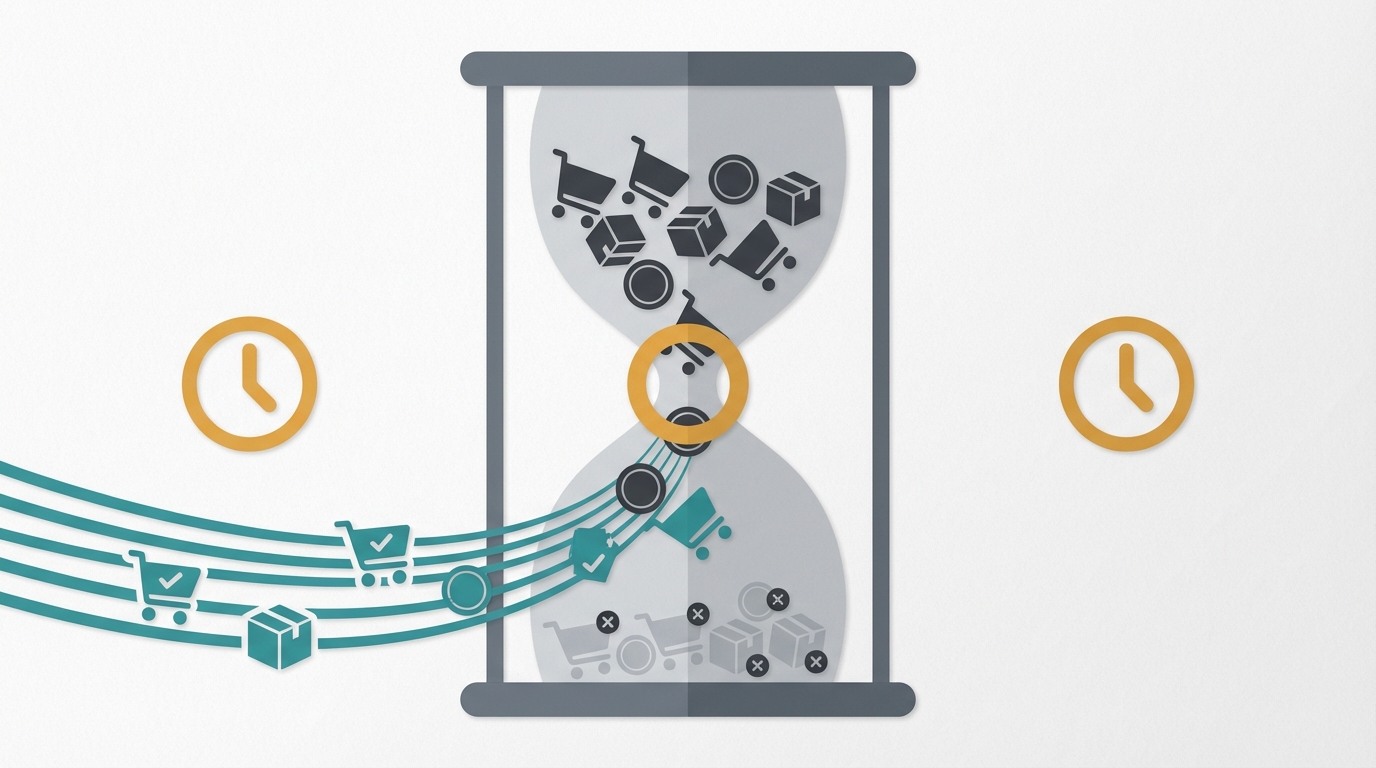
Current Cart Abandonment Statistics (2025 Data)
Overall Abandonment Rates by Industry:- Fashion/Apparel: 68%
- Beauty/Cosmetics: 70%
- Electronics: 74%
- Home/Furniture: 72%
- Health/Wellness: 67%
- Food/Grocery: 61%
- Desktop: 69%
- Tablet: 72%
- Mobile: 78%
- Highest: Sunday (74%)
- Lowest: Tuesday (67%)
Why Shoppers Abandon Carts: The 12 Root Causes
12 root causes drive cart abandonment, with unexpected costs alone responsible for 48% of all exits (Baymard Institute, 2025): 1. Unexpected Costs (48%) Surprise shipping fees, taxes, or processing charges at checkout frustrate customers into abandoning. Stores that display total costs before checkout reduce unexpected-cost abandonment by 31%. 2. Account Creation Required (26%) Mandatory account creation adds 4 unnecessary steps to checkout. Guest checkout eliminates this friction entirely. 3. Complicated Checkout Process (22%) Checkouts exceeding 5 steps, confusing form fields, or unclear navigation increase drop-off by 22%. 4. Security Concerns (18%) Payment security anxiety affects 18% of abandoners, particularly on stores lacking visible SSL indicators or trust badges. 5. Website Errors/Crashes (17%) Technical failures — page load timeouts, broken payment forms, JavaScript errors — eliminate conversions instantly. 6. Slow Delivery (16%) Delivery estimates exceeding 7 days push 16% of customers to competing stores offering faster fulfillment. 7. Return Policy Concerns (12%) Unclear or restrictive return policies create hesitation that a visible 30-day return guarantee removes. 8. Insufficient Payment Options (11%) Missing PayPal, Apple Pay, or Buy Now Pay Later options — such as Shop Pay Installments or Afterpay — cause 11% of exits. 9. Comparison Shopping (10%) Customers who add to cart across 3–5 competing stores simultaneously abandon with no immediate purchase intent. 10. Price Too High (9%) Cart totals exceeding the customer's mental price anchor by more than 20% trigger abandonment. 11. Card Declined (4%) Payment failures from declined cards or processor errors terminate 4% of checkout sessions. 12. Distraction (Variable) External interruptions — phone calls, meetings, childcare — account for a variable 8–15% of abandonment depending on device and time of day.The True Cost of Abandoned Carts
A store generating $1M in annual revenue loses $2.3M in potential revenue to cart abandonment at the 70% industry rate:- Recovering 15% of abandoned carts generates $345,000 in incremental revenue
- Recovering 25% generates $575,000 in incremental revenue
The Cart Recovery Framework: From Abandonment to Conversion
Effective cart recovery deploys 4 sequential stages across email, SMS, and paid retargeting, timed to customer behavior signals. Each stage targets a distinct psychological window after abandonment.Stage 1: On-Site Recovery (Exit Intent & Retention)
Exit-intent intervention retains 5–8% of abandoning customers before they leave the site. Triggering an overlay when the cursor moves toward the browser close button — or when the back button activates on mobile — captures customers at peak intent. 4 exit-intent interventions that reduce abandonment:- Cart content reminder with product images
- Save-cart-for-later offer with email capture
- Limited-time incentive (free shipping or 10% discount)
- Free shipping threshold indicator showing the gap to qualify
- Display 1 intervention per session — not multiple sequential popups
- Make the dismiss action prominent and frictionless
- Test incentive versus no-incentive variants across 500+ sessions for statistical validity
- Personalize the offer based on cart value thresholds (e.g., carts above $150 receive free shipping; carts below receive 10% off)
Stage 2: Immediate Response (0–1 Hour)
The first hour after abandonment produces the highest recovery rate of any window — 3–5x higher than messages sent after 24 hours. Customers retain product memory and purchase intent within this window. Email #1: The Reminder- Sends within 30–60 minutes of abandonment
- Uses a helpful, non-promotional tone ("Did you forget something?")
- Displays cart contents with product images and variants
- Includes a single high-contrast "Complete Order" CTA
- Withholds discount — no incentive needed at this stage
Stage 3: Nurture Sequence (1–72 Hours)
The 3-email nurture sequence sent between 1 and 72 hours recovers an additional 6–9% of abandoned carts that the first-hour reminder does not convert. Email #2: The Incentive (24 Hours)- Introduces free shipping or a 10% discount for price-sensitive segments
- Adds 3–5 customer reviews from Yotpo or Okendo as social proof
- Addresses the 3 most common objections: price, shipping time, return policy
- Creates mild urgency through low-stock indicators
- Declares cart expiration or offer deadline explicitly
- Escalates incentive to 15% off for high-cart-value segments
- Suggests 3 alternative products if original items drop below 5 units in stock
- Uses final-chance framing without false urgency
Stage 4: Re-engagement (3–30 Days)
Cart abandoners who receive re-engagement campaigns between days 3 and 30 convert at 2–4%, generating revenue that standard 72-hour sequences leave uncaptured. Browse abandonment integration triggers a follow-up when a non-converting customer returns to browse the same product category — a behavioral signal that purchase intent persists. Product-based follow-up via Klaviyo back-in-stock or price-drop flows notifies abandoners when their specific abandoned product restocks or drops in price. Win-back campaigns via Omnisend or Klaviyo enroll 30-day non-converters into a 4-email reactivation sequence that rebuilds purchase intent.Cart Recovery Workflow Template
Get our starter n8n workflow for abandoned cart recovery. Includes webhook trigger, wait timers, purchase checking, and 2-email sequence. Requires customization for your email provider and store.
Need the full AI-powered version? Talk to our team
Email Recovery: The Foundation of Cart Recovery
Email generates 80% of all cart recovery revenue across Shopify stores, making it the highest-ROI channel before paid retargeting spend (Klaviyo 2025 Email Benchmark Report).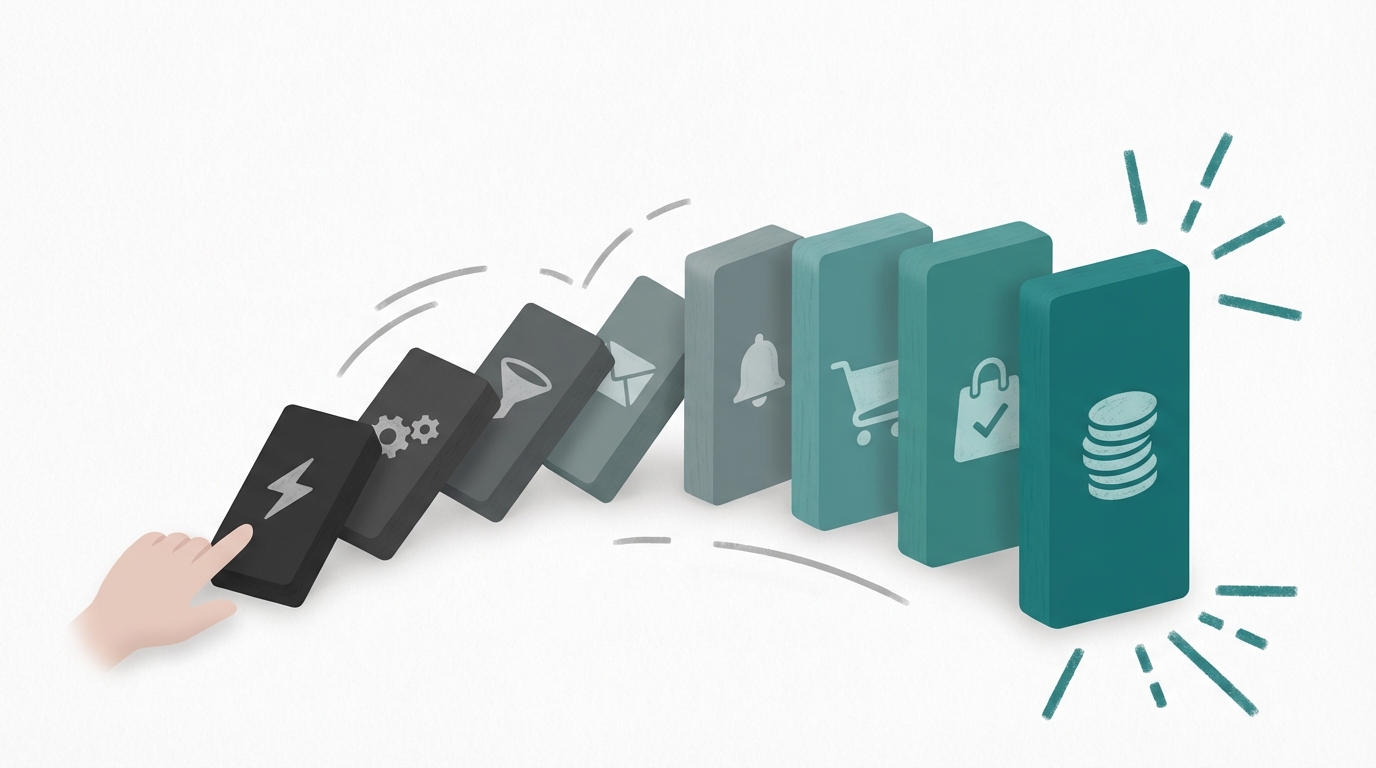
The Perfect Abandoned Cart Email Sequence
Email 1: The Reminder (1 Hour Post-Abandonment)Subject Line Examples:
- "Still thinking about it?"
- "You left something behind"
- "Your cart is waiting"
Content Elements:
- Friendly, non-pushy tone
- Cart contents with product images
- Clear "Complete Order" button
- Easy way to contact for questions
- No discount necessary
Timing: 30–60 minutes after abandonment
Expected Performance:- Open rate: 40–50%
- Click rate: 10–15%
- Conversion rate: 3–5%
Subject Line Examples:
- "Still interested? Here's free shipping"
- "Your cart + a special offer"
- "Don't miss out—10% off your order"
Content Elements:
- Acknowledgment of their browsing session
- Incentive introduction — free shipping or 10% discount
- 3–5 Yotpo reviews with star ratings
- 3 product recommendations based on cart contents
- Low-stock urgency indicator (e.g., "Only 4 left")
Timing: 24 hours after abandonment (or 23 hours after Email 1)
Expected Performance:- Open rate: 35–45%
- Click rate: 8–12%
- Conversion rate: 2–4%
Subject Line Examples:
- "Last chance: Your cart expires soon"
- "Final reminder: Complete your order"
- "Going, going..."
Content Elements:
- Explicit cart expiration timestamp
- Escalated incentive (15% off) for high-value cart segments
- 3 alternative product suggestions for out-of-stock items
- Single high-contrast final CTA
Timing: 48–72 hours after abandonment
Expected Performance:- Open rate: 30–40%
- Click rate: 6–10%
- Conversion rate: 1–3%
Subject Lines That Get Opened
Curiosity-Based:- "Quick question about your order"
- "Was it something we said?"
- "Before you go..."
- "Your cart is waiting"
- "Don't forget your [Product Category]"
- "You left [Product] behind"
- "Your cart expires in 24 hours"
- "Last chance for free shipping"
- "[Product] is almost sold out"
- "10% off to complete your order"
- "Free shipping—just for you"
- "We saved your cart + a surprise"
- "[Name], your cart misses you"
- "Still thinking about [Product Name]?"
- "[Name], come back for [Category]"
Email Design Best Practices
Above the Fold:- Cart contents visible without scrolling
- Primary CTA above the fold
- 3 trust signals: SSL badge, return policy, customer reviews
- High-resolution product images
- Product names, variants, and sizes
- Individual prices, quantities, and cart total
- High-contrast button color tested against background
- Action-oriented copy: "Complete My Order" or "Return to Cart"
- CTA repeated 3 times in emails exceeding 400 words
- Single-column layout for screens under 480px
- Tap targets minimum 44px × 44px
- Text readable at default font size without pinch-zoom
SMS Cart Recovery: The High-Conversion Channel
SMS cart recovery delivers a 98% open rate versus email's 20%, making it the highest-visibility channel for time-sensitive abandonment recovery (Klaviyo 2025 Email Benchmark Report).When SMS Beats Email
SMS outperforms email across 4 specific conditions:- Customer opted into SMS through Attentive, Postscript, or Klaviyo SMS and has engaged within the last 30 days
- Timing is critical — flash sale ending within 2 hours or stock dropping below 3 units
- Email deliverability drops below 85% open-delivery rate for the segment
- Mobile-first customer base where 70%+ of sessions originate from smartphones
SMS Timing and Frequency
Optimal Timing:- First SMS: 30–60 minutes after abandonment — use as Email 1 alternative, not a duplicate
- Follow-up SMS: 24 hours after abandonment, only if email sequence produced zero clicks
- 2 SMS messages per abandoned cart event maximum
- Space SMS and email by at least 30 minutes to avoid channel saturation
- Process Postscript or Attentive unsubscribes within 10 seconds via webhook
SMS Content Best Practices
Keep It Short:- 160 characters ideal — 1 message unit, no carrier splitting
- Maximum 2–3 sentences
- 1 clear link via tracked short URL
Message 1 (Reminder): "Hey [Name]! You left [Product] in your cart. Complete your order here: [Link] - [Brand]"
Message 2 (Incentive): "Still thinking about it? Here's 10% off your cart: [Code]. Complete your order: [Link] - [Brand]"
Include:- First-name personalization
- Specific product name from cart
- Tracked link with UTM parameters
- Brand name for sender identification
- STOP opt-out instruction (legally required in all US jurisdictions)
Compliance Requirements
TCPA (US):- Explicit written consent required before first message — pre-checked boxes do not qualify
- Honor opt-outs within 10 days — Postscript and Attentive process these in real time
- Send only between 8:00 AM and 9:00 PM in the recipient's local time zone
- Identify the sending brand in every message
- Separate, explicit consent required for SMS marketing — bundled consent is invalid
- One-click unsubscribe accessible in every message
- Data retention limited to 24 months without re-consent
AI-Powered Cart Recovery: The 2025 Advantage
AI-powered cart recovery increases recovery rates from 10% to 22% — a 120% improvement — while reducing discount usage by 35% compared to standard automation sequences.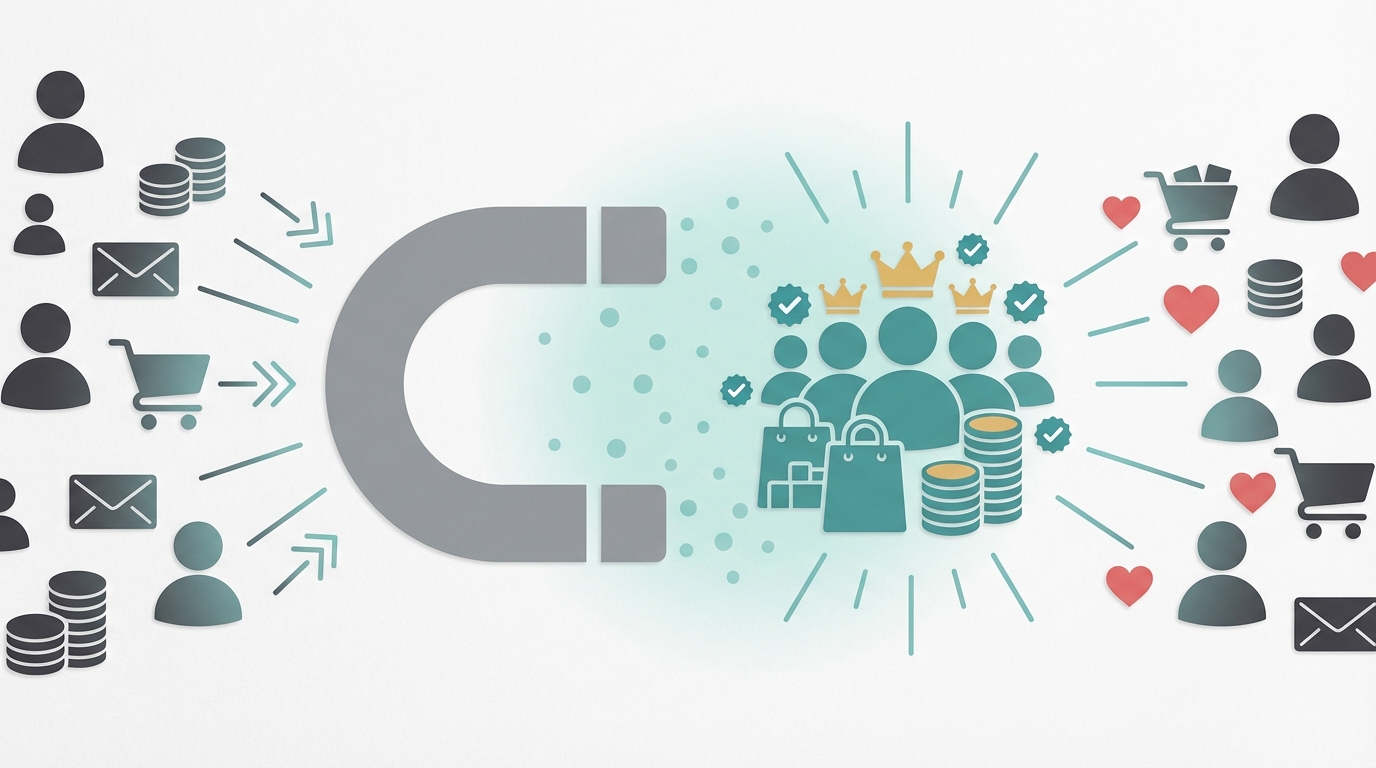
How AI Transforms Recovery Rates
Behavioral Prediction AI analyzes 12+ behavioral signals per customer session to predict 4 critical recovery variables:- Conversion probability without any incentive
- Minimum incentive level that triggers purchase (free shipping versus 10% versus 15% off)
- Highest-converting channel — email via Klaviyo, SMS via Attentive, or display retargeting via Meta
- Optimal send time based on 90-day individual engagement history
- First-time visitors versus returning customers with purchase history
- High-value carts above $200 versus low-value carts under $50
- Frequent purchasers (3+ orders) versus new prospects on first visit
- Mobile-first users versus desktop researchers
Results: AI vs. Standard Automation
Based on client implementations:
| Metric | Standard | AI-Powered | Improvement |
|---|---|---|---|
| Recovery Rate | 10% | 22% | +120% |
| Revenue per Cart | $8.50 | $18.75 | +120% |
| Discount Usage | 65% | 42% | -35% |
| Unsubscribe Rate | 0.8% | 0.4% | -50% |
Retargeting and Paid Recovery Strategies
Paid retargeting recovers 3–7% of abandoners who never open email — a segment that standard owned-channel sequences miss entirely.Facebook/Instagram Dynamic Product Ads
Setup Requirements:- Facebook Pixel with AddToCart and InitiateCheckout events firing correctly
- Product catalog synced and updated within 24 hours
- Custom audience of cart abandoners with a 7-day lookback window
- Display the exact abandoned product with original price and current availability
- Include product rating from Yotpo or Okendo directly in the ad creative
- Test discount-inclusive versus price-only creative across 1,000+ impressions before scaling
- Exclude purchasers using a 30-day purchase event exclusion audience
- CTR: 1–3%
- ROAS: 8–15x (varies by product category and average order value)
Google Display Remarketing
Setup Requirements:- Google Ads account with remarketing tag firing on all pages
- Dynamic remarketing feed connected to product catalog
- Audience segments for cart abandoners, checkout abandoners, and product viewers
- Deploy dynamic remarketing to serve the exact abandoned product image automatically
- Set frequency caps at 3–5 impressions per day per user to prevent ad fatigue
- Test 3 distinct messaging angles: reminder, urgency, and social proof
- Rotate creative every 14 days to prevent banner blindness
Coordinating Paid with Owned Channels
Avoid Over-Saturation:- Suppress converted customers from retargeting audiences within 1 hour of purchase
- Separate email incentive windows from retargeting discount creative by at least 48 hours
- Align Meta ad copy with the active email subject line for message consistency
- Email and SMS first — zero incremental cost per send
- Retargeting activates for customers who did not open email within 24 hours
- Retargeting runs as reinforcement for email openers who clicked but did not purchase
Segmentation Strategies for Maximum Recovery
Segmented recovery sequences outperform single-sequence approaches by 43% on recovery rate because each abandoner type responds to a distinct message and incentive structure.The Cart Abandoner Segmentation Matrix
Price-Sensitive Abandoners- Behavior: Reached order summary page, exited immediately after seeing total with shipping
- Recovery: Lead with free shipping or 10% discount in Email 1 — skip the no-incentive reminder
- Messaging: Emphasize total savings, cost-per-use framing, and price-match guarantee
- Behavior: Session under 90 seconds, immediate add-to-cart, no product page scroll depth
- Recovery: Differentiate from the 3–5 competitors they are evaluating simultaneously
- Messaging: Unique value propositions, 4.8-star Yotpo rating, brand trust indicators
- Behavior: Progressed to payment step, exited on card entry or shipping address field
- Recovery: Offer Shop Pay, PayPal, or Apple Pay as alternative payment methods
- Messaging: "Need help completing your order?" with direct support link to Gorgias live chat
- Behavior: High session engagement (3+ minutes, 5+ page views), standard abandonment pattern
- Recovery: Simple reminder — no aggressive discount or urgency needed
- Messaging: Friendly "Your cart is waiting" with a single clean CTA
Personalizing Recovery by Segment
First-Time Visitors:- Build trust before selling — include 5 Yotpo reviews, security badge, and 30-day return guarantee
- Highlight return policy in Email 1 body copy
- Deploy a 15% welcome discount in Email 2 to overcome new-brand hesitation
- Acknowledge 2–3 previous sessions explicitly: "You've visited us before"
- Ask whether a specific question or concern prevents purchase — link to Gorgias chat
- Address the 3 most common objections for this product category
- Use a 1-email reminder — returning customers need a nudge, not a persuasion sequence
- Reference their previous order to establish continuity and trust
- Offer loyalty points via Yotpo Loyalty or LoyaltyLion instead of a blanket discount
- Replace automated sequences with a personal email from a named team member for carts above $500
- Offer white-glove service: free expedited shipping, dedicated support line, product consultation
- Exclude from generic Klaviyo flows — route to a dedicated VIP abandoned cart flow with manual review
Measuring Cart Recovery Success
Recovery rate and revenue per abandoned cart are the 2 primary metrics that determine whether a cart recovery system creates measurable business impact.Key Metrics and Benchmarks
Recovery Rate- Formula: Recovered carts ÷ Total abandoned carts × 100
- Benchmark: 5–10% (industry average), 15–25% (optimized), 25%+ (AI-powered)
- Formula: Total recovered revenue ÷ Total abandoned carts
- Benchmark: $8.50 (standard automation), $18.75 (AI-powered) — use this metric to compare flow variants
- Open rate benchmark: 40–50% (cart emails outperform all other automated email types)
- Click rate benchmark: 10–15%
- Conversion rate benchmark: 3–8%
- Measure first-touch attribution (which channel initiated recovery) and last-touch (which channel closed the sale)
- Klaviyo's multi-touch attribution report separates email, SMS, and paid channel contribution within a single dashboard
Attribution Challenges
Cart recovery attribution produces double-counting errors in 34% of implementations because customers open email, close it, and return directly — crediting the direct visit instead of the email. Best Practices:- Apply consistent 5–7 day attribution windows across all channels in Klaviyo, Attentive, and Google Ads
- Track both click-through and view-through conversions with separate reporting columns
- Deduplicate conversions across Klaviyo, Postscript, and Meta using order ID as the deduplication key
- Establish a no-recovery baseline by suppressing 5% of abandoners from all flows for 30 days — this isolates true incremental lift
Calculating True Recovery ROI
Revenue Attribution: Total recovered revenue − Revenue that recovered organically without any intervention (baseline) Costs:- Klaviyo or Omnisend platform fees allocated to cart recovery flows
- Attentive or Postscript SMS spend per recovered cart
- Meta and Google retargeting spend attributed to cart abandoner audiences
- Discount costs: total face value of coupon codes redeemed in recovery flows
- Recovered revenue: $50,000/month
- Baseline organic recovery: $10,000/month
- Incremental revenue: $40,000
- Total costs: $3,000 (platform fees + retargeting + discounts)
- ROI: 1,233% — every $1 spent on recovery returns $13.33 in incremental revenue
Platform-Specific Setup Guides
Klaviyo, Omnisend, and Shopify's native tools each support cart recovery automation in 5 steps, with Klaviyo delivering the most complete segmentation and AI-optimization capabilities.Klaviyo Cart Recovery Setup
Klaviyo's pre-built abandoned cart flow reduces setup time to under 2 hours for Shopify stores:- Confirm the Shopify–Klaviyo integration syncs StartedCheckout events in real time
- Navigate to Flows → Browse pre-built flows
- Select the "Abandoned Cart" flow template
- Customize timing (30 min / 24 hr / 72 hr), segment filters, and discount conditions
- Enable the flow and monitor open rate, click rate, and revenue per recipient in the Klaviyo flow analytics dashboard
Omnisend Implementation
Omnisend integrates email and SMS cart recovery into a single 5-step workflow, making it the fastest setup for stores that want both channels without a separate SMS platform:- Connect Shopify or WooCommerce via Omnisend's native integration
- Access Automation → Cart Abandonment template
- Configure the 3-email plus 2-SMS sequence with individual channel timing
- Set segment conditions: new subscriber, returning customer, cart value above $100
- Launch and review the Omnisend automation report after 7 days for initial optimization
Shopify Native Tools
Shopify's built-in abandoned checkout email covers 1 touchpoint — sufficient for stores under $10,000/month in revenue, insufficient for stores with meaningful recovery opportunity:- Settings → Checkout → Abandoned checkouts
- Enable automatic email sending
- Customize the single-email template with brand colors and product images
- Upgrade to Klaviyo when monthly abandoned cart revenue opportunity exceeds $5,000 — Klaviyo's 3-email sequence with segmentation recovers 3–5x more revenue than Shopify's single email
Advanced Strategies for High-Volume Stores
Stores processing 500+ cart abandonments per month generate statistically valid A/B test results in 14 days, enabling continuous optimization across timing, incentive level, and creative variables.A/B Testing Your Recovery Flows
6 variables that produce measurable recovery rate improvement when tested:- Subject lines — curiosity-based versus direct versus urgency-based
- Send timing — 30 minutes versus 60 minutes for Email 1
- Incentive levels — no discount versus free shipping versus 10% off
- Email design — product-image-first versus text-first versus hybrid layouts
- CTA copy — "Complete My Order" versus "Return to Cart" versus "Claim Your Items"
- Sequence length — 2-email versus 3-email versus 4-email flows
- Split abandoned carts randomly at the flow entry point — 50/50 for binary tests
- Run each test for 14 days minimum or 200 conversions, whichever comes first
- Use recovery rate as the primary success metric and revenue per cart as the secondary
- Implement the winning variant immediately — do not run extended tests past 30 days
Seasonal Adjustments
BFCM and holiday peak seasons require 3 specific modifications to standard recovery flows because competitive pressure and genuine scarcity compress the purchase decision window:- Shorten the 3-day sequence to 48 hours — stock depletion is real and customers know it
- Increase Email 2 incentive to 15% off — the competitive environment justifies stronger offers
- Add a live inventory counter showing units remaining to reinforce authentic urgency
- Extend the nurture sequence from 72 hours to 7 days — purchase timelines lengthen without competitive pressure
- Shift messaging focus from urgency to value, quality storytelling, and brand differentiation
- Use Klaviyo predictive analytics to identify the 20% of slow-season abandoners with highest lifetime value potential and route them to a longer 6-email nurture sequence
VIP and Repeat Customer Handling
VIP customers — defined as those with 3+ orders or lifetime value above $500 — convert 2x faster than new visitors and require a fundamentally different recovery approach than standard automation. 3 modifications for VIP abandoned cart handling:- Replace the automated Klaviyo flow with a personal plain-text email from a named team member for carts above $500
- Offer white-glove incentives — free expedited shipping, dedicated phone line, early access to new inventory — instead of percentage discounts
- Integrate Yotpo Loyalty points as the recovery incentive — VIP customers respond to points accumulation 40% more than to one-time discount codes
Related: read our complete cart recovery guide
Ready to Recover More Revenue?
The gap between a 10% and 25% recovery rate produces $345,000 in additional annual revenue for a $1M store — achieved through systematic optimization across timing, messaging, channel sequencing, personalization, and measurement.Smart Circuit builds AI-powered cart recovery systems for e-commerce brands on Shopify and WooCommerce. Our clients average a 22% recovery rate — more than double the 10% industry standard.
Book Your Free Cart Recovery Audit →Smart Circuit's audit analyzes your current Klaviyo or Omnisend flow performance, identifies the 3–5 highest-impact optimization opportunities, and quantifies exactly what a 22% recovery rate means for your specific revenue.