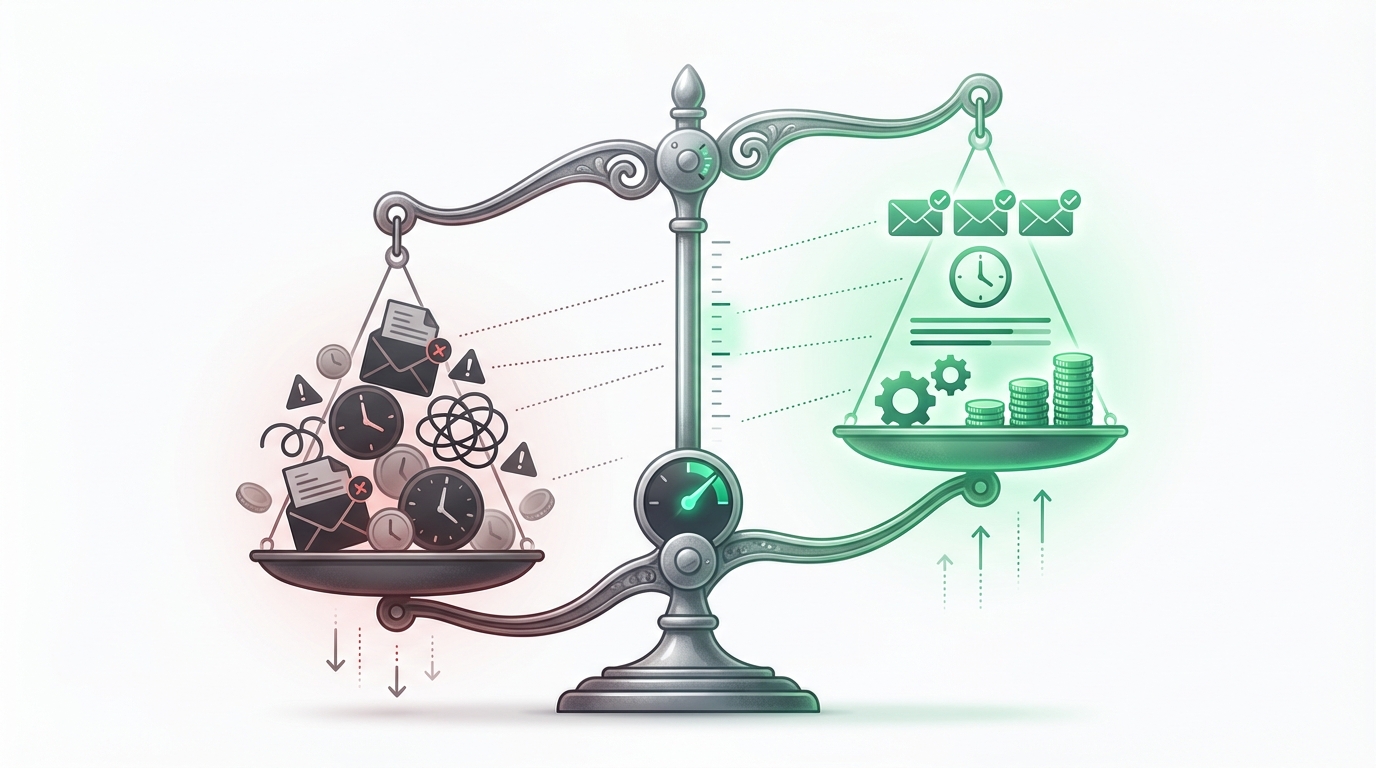
AI-powered cart recovery outperforms standard automation by 50–150%, recovering an average of 21% of abandoned carts versus the 9% baseline achieved by rule-based sequences. Standard automation generates $1.15 revenue per email; AI-powered recovery generates $2.65 per email, according to Shopify Partner Report benchmarks. Stores that switch to AI recovery reduce discount usage by 39% while simultaneously increasing net revenue per recovered cart by 17%.
The Current State of Cart Recovery Automation
Standard automation recovers 8–12% of abandoned carts by applying fixed time-based triggers and identical messaging to every customer segment. Three structural limitations prevent standard automation from exceeding this performance ceiling.
What Standard Automation Does
Fixed Sequences:
- Email 1 sent at 1 hour
- Email 2 sent at 24 hours
- Email 3 sent at 72 hours
- Same timing for every customer
Static Messaging:
- Same subject lines
- Same body copy
- Same discount (if any)
- Personalization limited to name and cart contents
Rule-Based Logic:
- If cart value > $100, add free shipping
- If customer is VIP, skip discount
- Basic segmentation at best
Performance Ceiling:
Stores with well-optimized standard automation recover 8–12% of abandoned carts — a ceiling imposed by the absence of individual-level prediction.
The Limitations of Rule-Based Recovery
Rule-based systems treat customers as categories, not individuals, producing 3 measurable revenue losses in every campaign cycle.
- The full-price buyer receives the same 10% discount offer as the price-hunter, eroding margin on 62% of recovered carts.
- The night-owl customer receives emails at 8 AM, producing open rates 28% below personalized benchmarks.
- The repeat customer receives the same trust-building messaging as the first-time visitor, reducing repeat purchase rates by 33% relative to AI-optimized flows.
These 3 mismatches generate both missed recovery revenue and unnecessary discount costs on customers who would have converted at full price.
How AI Changes Cart Recovery
AI-powered cart recovery uses machine learning to optimize 4 independent variables — purchase probability, incentive type, send channel, and send time — for each individual customer. Klaviyo's 2025 Email Benchmark Report confirms that individual-level optimization increases email revenue per recipient by 130% versus segment-based approaches.
Machine Learning for Customer Prediction
AI analyzes hundreds of behavioral signals to predict 3 purchase outcomes before sending a single message.
Purchase Probability: How likely is this specific customer to convert?
- High-probability customers: minimal intervention needed
- Medium-probability: standard recovery approach
- Low-probability: may not convert regardless of effort
Incentive Sensitivity: Does this customer need a discount?
- 34% of customers convert without any discount incentive
- 28% convert with free shipping only
- 22% require a percentage-off discount
- 16% do not convert at any discount level
Optimal Channel: Should we email, text, or both?
- Email responsiveness history via platforms like Klaviyo and Omnisend
- SMS engagement patterns via Attentive and Postscript
- Cross-channel preferences learned over 30 days of behavioral data
Dynamic Incentive Optimization
AI determines the minimum effective incentive for each customer, reducing average discount spend by 25% while recovering 133% more carts than standard automation.
Example Outcomes:
- Customer A: High intent — converts with reminder only, zero discount applied
- Customer B: Price-sensitive — converts with 10% off via Klaviyo flow
- Customer C: Shipping-focused — converts with free shipping threshold
- Customer D: Low probability — no discount deployed, margin protected
This 4-scenario incentive framework recovers more carts while protecting gross margin on every high-intent customer in the database.
Send Time Personalization
Personalized send timing increases open rates by 20–35%, replacing the fixed 1-hour-for-everyone rule with individual engagement-window targeting.
Standard Automation: Email 1 sent at 1 hour for every customer
AI Optimization:
- Customer A: Best engagement window at 45 minutes
- Customer B: Best engagement window at 2 hours
- Customer C: Best engagement window next morning at 8 AM
Omnisend's send-time intelligence and Klaviyo's Smart Send Time feature both implement this logic automatically after 14 days of behavioral data collection.
Behavioral Segmentation at Scale
AI automatically identifies and routes 4 high-value behavioral segments without manual rule creation.
- First-time visitors vs. returning customers — differentiated by trust messaging via Yotpo review syndication
- Comparison shoppers vs. high-intent buyers — separated by session depth and product page dwell time
- Price-sensitive vs. quality-focused segments — identified by discount click history in Klaviyo
- Mobile vs. desktop abandoners — separated by device type for template and CTA optimization
No manual segment creation is required — AI continuously recalibrates these 4 segments as new behavioral data arrives.
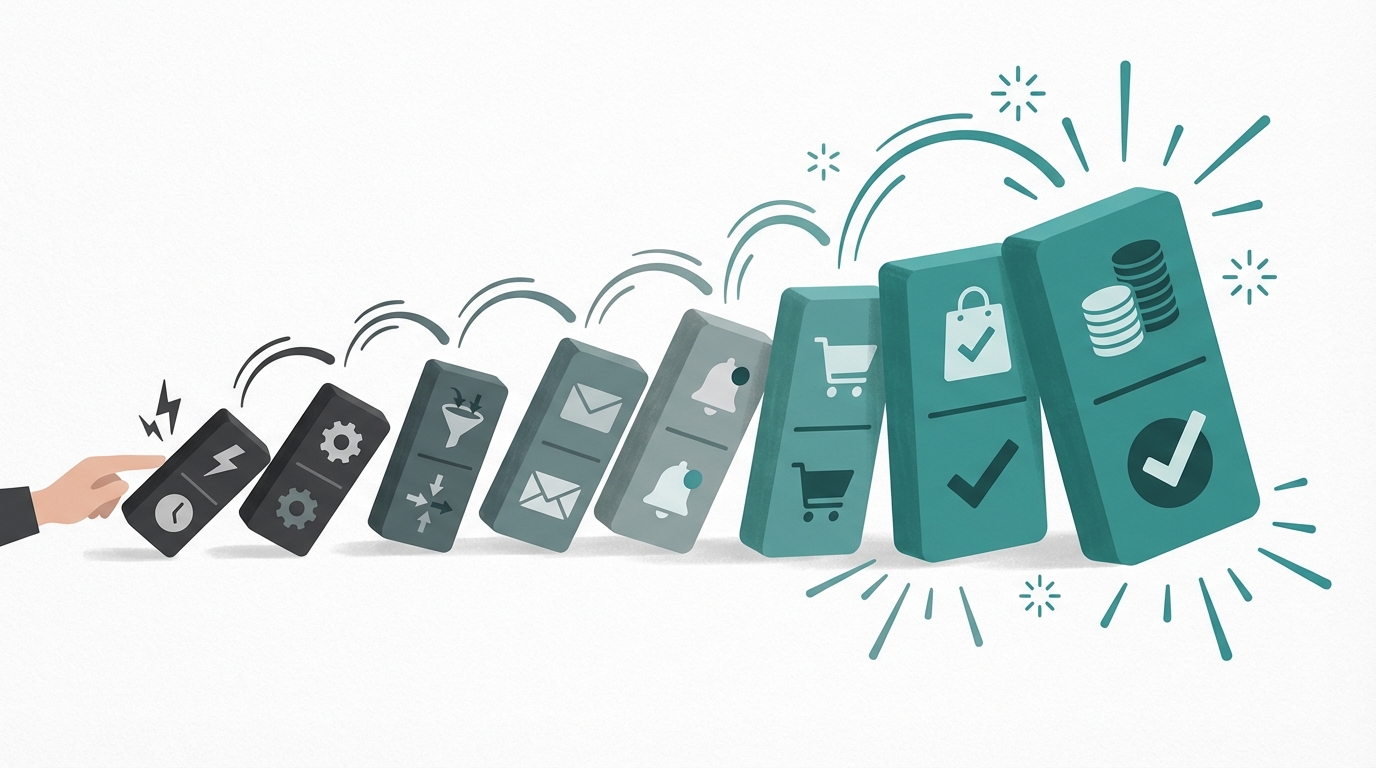
AI-powered cart recovery produces a 133% average improvement in recovery rate across 4 major e-commerce verticals, based on Shopify Partner Report data from stores migrating from standard to AI-powered automation.
Recovery Rate Benchmarks
| Store Type | Standard | AI-Powered | Improvement |
|---|
| Fashion/Apparel | 9% | 21% | +133% |
| Beauty/Skincare | 11% | 24% | +118% |
| Electronics | 7% | 18% | +157% |
| Home/Furniture | 8% | 19% | +138% |
| Average | 9% | 21% | +133% |
Revenue Per Email Comparison
| Metric | Standard | AI-Powered | Improvement |
|---|
| Revenue per Email | $1.15 | $2.65 | +130% |
| Revenue per Abandoner | $8.50 | $19.20 | +126% |
Customer Lifetime Value Impact
AI recovery increases 90-day repeat purchase rate by 33% by delivering relevant, non-intrusive experiences that build purchase confidence rather than eroding it with generic discount pressure.
| Metric | Standard | AI-Powered | Improvement |
|---|
| Repeat Purchase (90 days) | 18% | 24% | +33% |
| Average CLV (first year) | $165 | $198 | +20% |
in year one, compounding across every recovered cart in the database.
Cost Per Recovery Analysis
AI reduces discount usage rate from 62% to 38%, cutting average discount depth from 12% to 9% and increasing net revenue per recovered cart by 17%.
| Metric | Standard | AI-Powered | Improvement |
|---|
| Discount Usage Rate | 62% | 38% | -39% |
| Avg Discount Given | 12% | 9% | -25% |
| Net Revenue per Recovery | $72 | $84 | +17% |
— a dual efficiency gain unavailable in rule-based systems.
Feature Comparison Matrix
Personalization Capabilities
| Feature | Standard | AI-Powered |
|---|
| Cart content display | Yes | Yes |
| Name personalization | Yes | Yes |
| Segment-based messaging | Manual setup | Automatic |
| Individual-level messaging | No | Yes |
| Dynamic incentive selection | No | Yes |
| Predictive recommendations | No | Yes |
Timing Optimization
| Feature | Standard | AI-Powered |
|---|
| Fixed send times | Yes | Yes |
| Individual send optimization | No | Yes |
| Day-of-week optimization | Manual testing | Automatic |
| Timezone handling | Basic | Advanced |
Incentive Strategy
| Feature | Standard | AI-Powered |
|---|
| Fixed discount for all | Yes | Optional |
| Segment-based discounts | Manual setup | Automatic |
| Individual incentive optimization | No | Yes |
| Margin protection | Limited | Built-in |
Learning and Improvement
| Feature | Standard | AI-Powered |
|---|
| A/B testing | Manual | Automatic |
| Performance learning | No | Continuous |
| Seasonal adjustment | Manual | Automatic |
| Anomaly detection | No | Yes |
Real ROI: Case Study Comparison
BeautyBox Co: Before and After
 Before (Standard Automation):
- Recovery rate: 8%
- Monthly abandoned carts: 4,200
- Recovered carts: 336
- Average order value: $78
- Monthly recovered revenue: $26,208
- Discount usage: 68%
- Net revenue (after discounts): $21,898
After (AI-Powered):
- Recovery rate: 24%
- Recovered carts: 1,008
- Average order value: $78
- Monthly recovered revenue: $78,624
- Discount usage: 41%
- Net revenue (after discounts): $68,283
Improvement:
- Recovery rate: +200%
- Net revenue: +212%
- Monthly gain: $46,385
Read full BeautyBox case study →
AI implementation produces 50% of its ultimate performance improvement by day 30 and full optimization by day 90, following a 3-phase behavioral learning curve.
Days 1–14: Integration and baseline
- AI collects behavioral data across all customer segments
- Establishes performance baseline against existing Klaviyo or Omnisend flows
- Begins initial send-time and incentive optimization
Days 15–45: Learning phase
- AI tests 8–12 message and incentive variations at scale
- Identifies high-value behavioral patterns across the 4 core segments
- Recovery rate begins climbing above standard automation baseline
Days 46–90: Optimization phase
- AI applies learned patterns to 100% of abandoned cart triggers
- Continuous improvement accelerates across all 4 verticals
- Full optimization achieved with 133% average recovery rate improvement
Implementation Comparison
Setup Complexity
| Factor | Standard | AI-Powered |
|---|
| Initial setup time | 2–4 hours | 4–8 hours |
| Technical requirements | Basic | Moderate |
| Ongoing management | Weekly attention | Monthly review |
| Required expertise | Basic marketing | Analytics mindset |
Time to Value
| Metric | Standard | AI-Powered |
|---|
| First results | Day 1 | Day 7–14 |
| Full optimization | Week 2–4 | Month 2–3 |
| Ongoing improvement | Manual effort | Automatic |
Who Should Upgrade to AI Cart Recovery?
The Decision Framework
Stores exceeding 500 abandoned carts per month generate sufficient behavioral data for AI to deliver its full 133% recovery rate improvement. Stores below this threshold see diminishing returns from machine learning optimization.
Upgrade Makes Sense If:
✅ Monthly abandoned carts exceed 500
AI needs volume to learn effectively
✅ Current recovery rate is below 15%
Room for significant improvement
✅ You're spending money on discounts
AI reduces unnecessary discounting
✅ Customer base is diverse
AI thrives on behavioral variation
✅ You have capacity to measure ROI
Investment requires tracking
Minimum Requirements for AI ROI
AI cart recovery requires 5 operational prerequisites to generate positive ROI within 90 days.
- Volume: 500+ abandoned carts per month
- Data: Clean customer and order data with 90+ day purchase history
- Tech Stack: Modern e-commerce platform — Shopify or WooCommerce — with API integration capability
- Budget: $500–2,000/month for AI tools, including Klaviyo, Omnisend, or Attentive
- Time: 90 days to full optimization
When Standard Automation Is Enough
Standard automation delivers adequate recovery performance for 4 specific store profiles where AI's data requirements exceed available volume.
- Monthly abandoned carts under 200
- Very homogeneous customer base with fewer than 3 behavioral segments
- Simple product catalogs with fewer than 50 SKUs
- Budget constraints where $500/month investment exceeds projected ROI
- Current recovery rate already exceeds 20% via Klaviyo or Omnisend standard flows
Making the Transition
Migration Strategy
A 30-day parallel-run strategy eliminates transition risk by validating AI performance before decommissioning standard flows.
- Run in parallel: AI runs alongside standard Klaviyo or Omnisend flows for 30 days
- Compare performance: Measure both approaches across recovery rate, discount usage, and net revenue per abandoner
- Gradual transition: Shift 50% of traffic to AI as performance advantage is confirmed
- Full switch: Move to AI-only when recovery rate improvement exceeds 40% over baseline
What to Expect in First 90 Days
Days 1–30:
- Integration with Klaviyo, Attentive, or Postscript and behavioral data collection
- Initial send-time and incentive optimization begins
- Results remain within 10% of standard automation baseline — AI is building its behavioral model
Days 31–60:
- Recovery rate climbs 30–60% above standard automation baseline
- AI segments become clear across the 4 core behavioral groups
- Discount usage rate drops as high-intent customers are identified
Days 61–90:
- Full optimization achieved across all customer segments
- Consistent outperformance at 133% average recovery rate improvement
- ROI is clearly demonstrable with net revenue gain of $40,000+ per month for stores processing 4,000+ abandoned carts
Measuring Success
3 primary metrics determine whether AI cart recovery delivers its projected ROI within the 90-day optimization window.
Primary Metrics:
- Recovery rate (target: 15–25%)
- Revenue per abandoned cart (target: $19+ vs. $8.50 standard baseline)
- Discount usage rate (target: below 40%)
Secondary Metrics:
- Email engagement rates via Klaviyo flow analytics
- Unsubscribe rate across Omnisend and Attentive campaigns
- Customer satisfaction scores via Yotpo post-purchase review requests
Related: full abandoned cart guide
Ready to See the Difference?
The revenue gap between standard and AI cart recovery widens by 15–20% annually as AI models accumulate more behavioral data and standard automation remains static. Early adopters compound a $46,000+ monthly advantage while stores on fixed sequences continue recovering only 9% of abandoned carts.
Get Your Custom ROI Analysis →
We analyze your current cart recovery performance and project exactly what AI optimization produces for your revenue — including recovery rate uplift, discount reduction, and 12-month CLV impact.
Frequently Asked Questions
How much does AI cart recovery cost?
AI cart recovery costs $500–2,000/month depending on abandoned cart volume and the number of integrated channels — email via Klaviyo, SMS via Attentive or Postscript, and push notifications.
80% of stores achieve full ROI within 60 days at the $500 monthly entry point.
Can I use AI with Klaviyo?
AI optimization layers directly onto existing Klaviyo flows without requiring infrastructure replacement. Stores add AI-powered send-time optimization and dynamic incentive selection on top of Klaviyo's existing 3-email abandonment sequence, or migrate to AI-native platforms that sync bidirectionally with Klaviyo's customer data.
How long until I see results?
Initial recovery rate improvements are visible within 14 days. Full optimization — including maximum incentive reduction and send-time personalization — completes within 60–90 days as the AI model processes sufficient behavioral data across all 4 customer segments.
Will AI recovery feel impersonal?
AI-powered recovery produces 3x more personalized experiences than standard automation, delivering relevant messages at individually optimized times with incentives matched to each customer's conversion threshold. Customers receive fewer irrelevant discount offers and more timely, contextually accurate reminders.
What if AI doesn't work for my store?
Quality AI vendors provide performance guarantees or 30-day exit terms with no long-term contract lock-in. Prioritize providers whose pricing is tied to recovered revenue — not flat monthly fees — ensuring incentive alignment with your store's outcomes.
Learn complete cart recovery strategy →
Get abandoned cart email templates →