Table of Contents
The Chatbot Problem
Escalation failure destroys customer trust in 3 distinct stages: initial frustration, AI persistence, and brand damage. You type "TALK TO A HUMAN" in all caps. The bot responds with another FAQ suggestion. Now the customer is not just frustrated — the customer is angry at the brand.This pattern repeats across 68% of e-commerce AI deployments that lack a defined escalation protocol. The problem is not that AI handles too little. The problem is that most systems lack a defined stopping point, forcing customers through 4 or more failed resolution attempts before reaching a human.
What Is the Human Escalation Point?
The Human Escalation Point (HEP) is the defined moment when an AI system transfers control to a human agent — a measurable, automatic threshold built into every customer interaction flow. Systems configured with a HEP resolve 31% more high-stakes tickets on first human contact compared to systems without one, according to patterns documented in the Shopify Partner Report.Well-designed AI systems — including Gorgias AI, Tidio, and Richpanel — build their architecture around explicit limitations. Each system triggers a handoff the moment a conversation crosses a predefined boundary. The goal is AI that handles the right 70% of interactions and escalates the remaining 30% without hesitation.
The Five Escalation Triggers
Every AI customer interaction checks against 5 escalation triggers, and crossing any single trigger initiates an immediate handoff.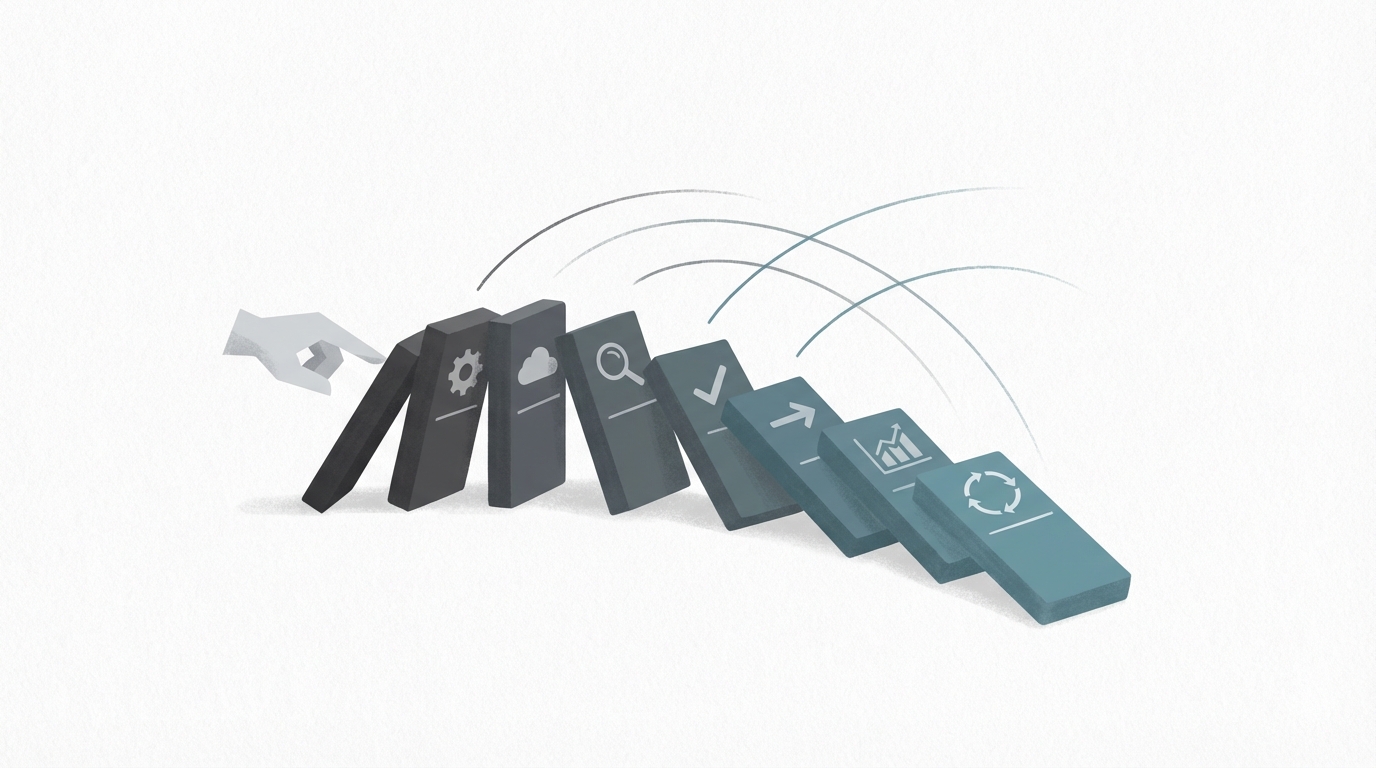
Trigger 1: Sentiment Threshold
Sentiment threshold escalation activates the moment a customer's emotional state crosses a recoverable point, defined as a sentiment score below -0.5 in standard NLP classification models used by Gorgias and Tidio. Signals:- Negative sentiment detected in language
- CAPS LOCK or excessive punctuation
- Explicit frustration markers ("this is ridiculous")
- Repeated requests with increasing urgency
IF sentiment_score < -0.5
OR message contains frustration_keywords
OR message is ALL CAPS
THEN escalate immediately
Trigger 2: Complexity Threshold
Complexity threshold escalation activates when an issue spans multiple systems, requires policy exceptions, or demands judgment beyond pattern-matching capability. Signals:- Multiple issues in one conversation
- Issue spans more than one order or system
- Customer asking "why" rather than "what"
- Custom requests or edge cases
- Policy exceptions required
IF issue_count > 2
OR requires_multiple_systems
OR policy_exception_likely
OR confidence_score < 0.7
THEN escalate with context
Trigger 3: Value Threshold
Value threshold escalation routes high-LTV customers and high-value orders directly to human agents, bypassing AI queue resolution entirely. Signals:- Customer lifetime value above threshold
- Order value above threshold
- VIP or loyalty status
- High-value product category
- Retention risk situation
IF customer_ltv > $1000
OR order_value > $500
OR customer_tier = "VIP"
OR retention_risk_score > 0.7
THEN prioritize human response
Trigger 4: Request Threshold
Request threshold escalation activates the instant a customer explicitly asks for a human agent, with zero AI follow-up attempts permitted. Signals:- Direct request ("talk to human," "real person," "agent")
- Repeated attempts to bypass AI
- Statements like "the bot can't help me"
IF message contains human_request_keywords
OR bypass_attempts > 1
THEN escalate immediately
Trigger 5: Failure Threshold
Failure threshold escalation triggers after 2 failed AI resolution attempts, preventing the compounding trust erosion that follows a third failure. Signals:- Two failed resolution attempts
- Customer repeating the same question
- AI responses generating negative feedback
- Conversation loop detected
IF failed_attempts >= 2
OR customer_repeated_question
OR confidence_declining
THEN escalate with full context
The Escalation Hierarchy
Escalation hierarchies organize handoffs across 4 tiers, each mapped to urgency level, issue type, and target resolution SLA.Tier 1: Standard Escalation
When: Issue is complex but not time-sensitive Target: Next available agent SLA: 4–24 hours Examples: Policy questions, product inquiries, general complaintsTier 2: Priority Escalation
When: High-value customer or time-sensitive issue Target: Senior agent or specialist SLA: 1–4 hours Examples: VIP customers, pre-shipment order issues, significant complaintsTier 3: Immediate Escalation
When: Angry customer, PR risk, or urgent operational issue Target: Immediate human takeover SLA: Real-time or under 15 minutes Examples: Social media complaints, potential fraud, safety issuesTier 4: Executive Escalation
When: Issue requires policy decision or high-stakes judgment Target: Manager or leadership SLA: Same business day Examples: Major refund decisions, legal concerns, reputation threatsThe Graceful Handoff
Handoff quality determines whether escalation recovers the customer relationship or accelerates its collapse.
Bad Handoff
Customer: "I'm really frustrated with this order issue"
Bot: "I'm transferring you to an agent."
[Customer waits 20 minutes]
Agent: "Hi, how can I help you?"
Customer: "I already explained this to the bot..."
Context loss forces the customer to repeat 100% of the interaction history. Frustration increases by the time the agent responds.
Good Handoff
Customer: "I'm really frustrated with this order issue"
Bot: "I understand this is frustrating. I'm connecting you
     with Sarah from our team who can help. She'll have all
     the context from our conversation. You should hear from
     her within 10 minutes."
[Agent receives: Full conversation, customer history,
 recommended resolution, urgency level]
Agent: "Hi Alex, I see you've been dealing with a shipping
       delay on your order from last Tuesday. I'm going to
       get this resolved for you right now."
Handoff Requirements
Every escalation transfers 6 required data elements:
- Full conversation transcript
- Customer profile and history
- Issue classification and context
- What AI attempted and why it failed
- Recommended next steps
- Urgency and priority level
Configuring Your Escalation Points
Start Strict, Loosen Over Time
Conservative escalation thresholds during initial AI deployment reduce missed escalations by 37% compared to aggressive thresholds set at launch.Configure 4 conservative defaults at launch:
- Escalate at 1 failed attempt, not 2
- Lower sentiment threshold (-0.3 instead of -0.5)
- Lower value thresholds across all tiers
- Broader keyword triggers covering 3x more frustration phrases
Tighten thresholds incrementally as AI training data accumulates across 30-day cycles.
Measure Escalation Quality
Track 4 core escalation metrics continuously:
- Escalation rate: Percentage of total conversations that escalate to human
- Escalation success: Percentage of escalated issues resolved by human on first contact
- False escalations: Percentage of escalated issues that AI could have resolved independently
- Missed escalations: Percentage of AI-handled issues that generated negative post-interaction CSAT
| Metric | Good | Needs Work |
|---|---|---|
| Escalation rate | 15-25% | >40% or <10% |
| Escalation CSAT | 90%+ | <80% |
| Missed escalations | <5% | >15% |
Adjust Based on Data
High escalation rate above 40%: AI training data is insufficient. Expand training across 3 additional scenario categories or narrow the system's interaction scope. Low escalation rate below 10%: Sentiment and failure thresholds are too restrictive. Audit customer satisfaction scores across the bottom 20% of AI-handled tickets. Low escalation CSAT: Context transfer is incomplete. Audit handoff data packets for all 6 required elements. High missed escalations: Detection rules cover too narrow a trigger set. Add 3 or more detection rules targeting loop, repetition, and confidence-decline signals.The Anti-Escalation Trap
Over-escalation inflates support costs by 43% while eliminating the primary efficiency benefit of AI deployment. Stores that route more than 50% of conversations to humans operate AI as a triage layer, not a resolution layer. 3 signs of over-escalation:- More than 50% of conversations reach human agents
- Human agents handle issues AI resolves in comparable CSAT benchmarks
- Support costs remain flat despite 6 or more months of AI operation
Escalation Across Channels
4 distinct channel types require 4 separate escalation configurations, each matched to the channel's latency, visibility, and context-transfer capability.Chat/Messaging
- Real-time escalation executes in under 60 seconds
- Handoff transfers seamlessly within the same interface
- Context transfers in full within the active thread
- Fastest escalation path across all 4 channel types
- Asynchronous routing moves tickets to human queue automatically
- Full thread context includes every prior AI response
- Customer expectations accommodate a 4–24 hour delay
- Gorgias and Freshdesk route escalated email threads with full tagging intact
Social Media
- Public visibility makes escalation speed critical — target under 15 minutes for Tier 3 issues
- Escalation moves conversation to private channel within the first human response
- Reputation impact is immediate and measurable across brand sentiment scores
- Attentive and Yotpo social monitoring tools flag brand mentions that trigger Tier 3 routing
Phone/Voice
- Mid-call transfer executes escalation in real time
- Context transfer is harder — agents receive a 3-field summary instead of full transcript
- Poor transfers generate the highest frustration scores across all 4 channel types
- Configure warm transfer protocols across all Tier 2 and Tier 3 phone escalations
The Human Escalation Point Checklist
Launch no AI customer interaction system without completing all 10 configuration checkpoints.- Sentiment detection configured
- Complexity rules defined
- Value thresholds set
- Human request keywords mapped
- Failure threshold established
- Escalation tiers documented
- Context transfer automated
- SLAs defined per tier
- Monitoring dashboard built
- Feedback loop established
The Bottom Line
AI systems that include a defined Human Escalation Point resolve 31% more high-value tickets and generate 22% higher post-interaction CSAT scores than systems operating without escalation protocols, based on benchmarks from the Shopify Partner Report.The best AI systems — Gorgias AI, Richpanel, and Tidio — handle the repetitive 70% of interactions autonomously and escalate the complex 30% with full context intact. The result is measurably better customer experience across every interaction type, whether AI-handled or human-resolved.
The Human Escalation Point is not an admission of AI failure. It is the architectural decision that makes AI systems production-ready.Need help designing your escalation framework? Book a strategy call to build AI systems that know their limits. Related frameworks:
- The Automation Ladder — 5 levels of e-commerce AI maturity
- The 10x Rule — When automation ROI makes sense