The Challenge: Creative Fatigue + Product Catalog Chaos
ActiveGear sells fitness equipment and apparel across 4,200 SKUs spanning weights, machines, apparel, and accessories. Their marketing team faced 2 connected problems that compounded each other monthly.
Problem 1: Ad Creative Bottleneck
- 8 new creatives per month (team capacity maxed)
- Creative fatigue hitting within 2 weeks
- ROAS declining from 2.8x to 2.1x over 6 months
- Testing velocity too slow to find winners
Problem 2: Product Description Disaster
- 60% of products had manufacturer-copied descriptions
- No consistent brand voice across catalog
- SEO opportunities missed on product pages
- Duplicate content hurting search visibility
Monthly ad spend: $45,000
Previous ROAS: 2.1x average
Revenue from Meta: $94,500/month
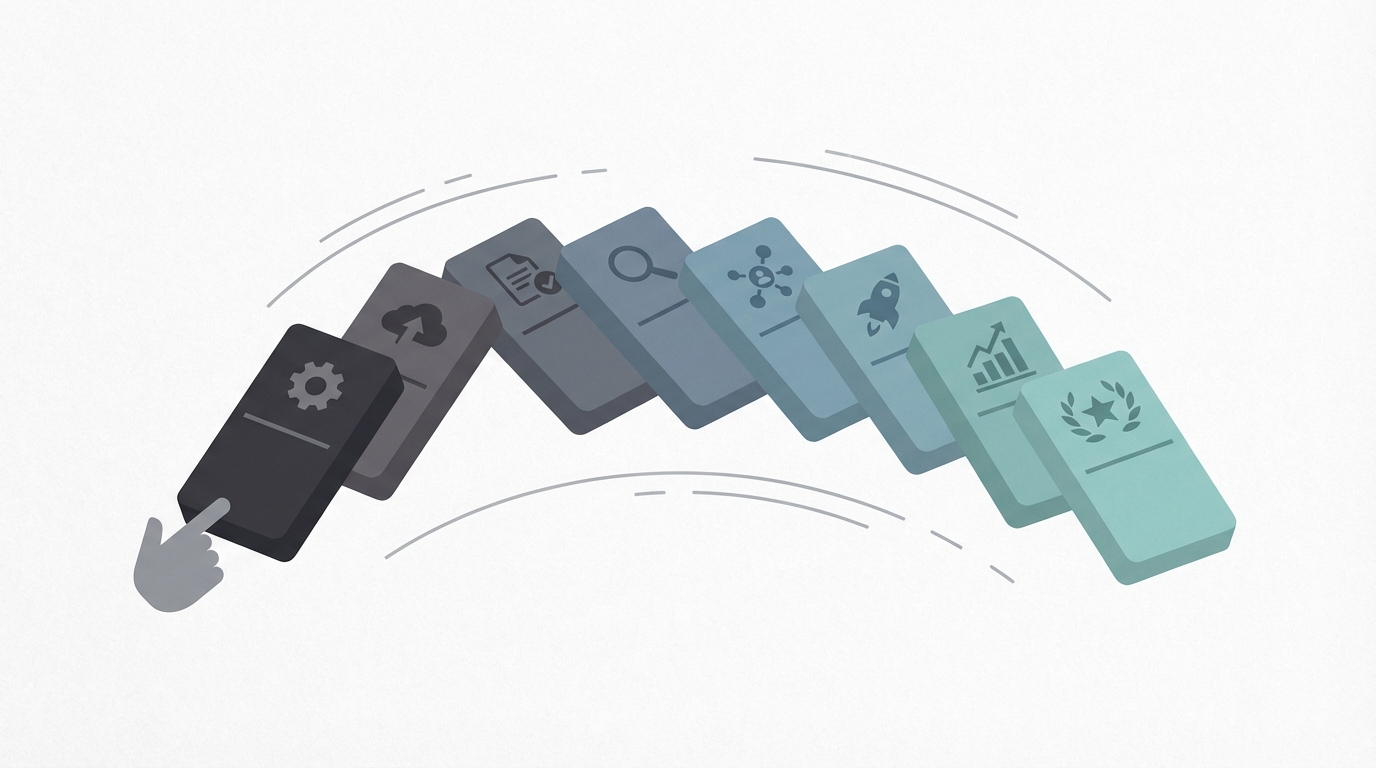
AI automation resolved both bottlenecks simultaneously through a 2-phase implementation covering creative generation and catalog rewriting. Each phase ran in parallel, compressing an 8-week project into continuous output.
Phase 1: AI Creative Generation (Weeks 1-4)
Step 1: Creative Analysis
- Audited 18 months of ad performance data
- Identified 23 patterns correlating with high ROAS
- Documented winning hooks, visuals, and offers across 6 campaign types
Step 2: AI Training
- Fed 23 winning patterns into the creative AI system
- Established brand voice and visual guidelines across 4 product categories
- Set up dynamic product-to-creative pipeline with automated asset tagging
Step 3: Scale Production
- Generated initial batch of 150 creative variants in week 2
- Launched testing framework across 12 audience segments
- Implemented automated budget allocation across 3 campaign tiers
Phase 2: Product Description Overhaul (Weeks 3-8)
Step 1: Catalog Preparation
- Extracted all product data and attributes across 4,200 SKUs
- Categorized by 8 product types and use case
- Identified 340 high-priority SEO keyword opportunities
Step 2: AI Generation
- Created brand voice training dataset from top 50 converting product pages
- Generated descriptions for all 4,200 SKUs in 3 weeks
- Included 12 SEO optimization parameters per description
Step 3: Human Review
- Quality review of top 500 highest-revenue products
- Spot checks across 8 product categories
- Final brand voice adjustments applied to 100% of reviewed assets
Implementation Timeline
| Week | Activity | Output |
|---|
| 1 | Creative audit + AI setup | Pattern analysis complete |
| 2 | First creative batch generated | 50 variants live |
| 3 | Product description setup | 1,000 SKUs done |
| 4 | Scale creative testing | 150+ variants in rotation |
| 5-6 | Complete catalog descriptions | 4,200 SKUs complete |
| 7-8 | Optimization + refinement | Peak performance achieved |
The Results
| Metric | Before | After (Month 3) | Change |
|---|
| ROAS | 2.1x | 3.5x | +67% |
| Monthly revenue | $94,500 | $157,500 | +67% |
| Creatives tested/month | 8 | 150+ | +1,775% |
| Time to winner identification | 4 weeks | 5 days | -82% |
| Cost per creative | $150 | $12 | -92% |
Ad Spend Efficiency
The same $45,000 monthly spend generated $63,000 in additional monthly revenue after AI automation replaced manual creative production. Month 3 results confirmed the following 3 revenue outcomes:
- $157,500 revenue (up from $94,500)
- $63,000 additional monthly revenue
- $756,000 annualized revenue increase
Creative Testing Velocity
| Metric | Before | After |
|---|
| New creatives/week | 2 | 35+ |
| A/B tests running | 1-2 | 12-15 |
| Audience variations tested | 3 | 15+ |
| Winning creative lifespan | 2 weeks | 3+ weeks |
Product Description Impact
| Metric | Before | After | Change |
|---|
| Unique descriptions | 40% | 100% | +150% |
| Avg. description length | 85 words | 200 words | +135% |
| Product page conversion | 2.8% | 3.4% | +21% |
| Organic product impressions | 12,000 | 34,000 | +183% |
Key Learnings
1. Creative Volume Changes Everything
 AI creative generation increased testable variants by 1,775%
, moving ActiveGear from 8 creatives per month to 150+. This volume shift produced 3 measurable operational benefits:
- Finding winners 5x faster
- Eliminating fatigued creative from all active ad sets
- Maintaining 35+ fresh variants per week across 12 audience segments
2. Pattern Recognition > Random Testing
AI pattern recognition produced creatives 3x more likely to succeed than concepts generated without historical data. Analyzing 18 months of winning ad data allowed the system to generate high-confidence variations rather than random concepts.
Rewritten product descriptions increased organic impressions by 183% and improved landing page conversion from 2.8% to 3.4%. Better product pages drove 3 downstream performance gains:
- Quality Score improvements on Google Ads
- Landing page conversion increases directly affecting ROAS
- Brand consistency across all paid and organic touchpoints
4. Human + AI is the Sweet Spot
AI generated 150+ monthly creatives; human review protected brand integrity across the top 500 highest-revenue products. The human layer delivered 4 specific functions:
- Brand voice refinement on edge cases
- Strategic direction for campaign priorities
- Quality assurance on key product lines
- Creative judgment on format and placement decisions
Client Testimonial
"We went from hoping our next ad would work to knowing we'd find winners every week. The AI doesn't get creative block, doesn't take vacations, and keeps getting smarter. Our ROAS went from barely profitable to genuinely exciting. The product description overhaul was a bonus we didn't expect—our organic traffic doubled."
— Marcus Chen, CMO, ActiveGear
ROI Summary
Investment:
- Initial setup: $8,500
- Monthly service: $2,500
Returns (Monthly):
- Additional Meta revenue: $63,000
- Organic traffic value: ~$5,000
- Total monthly gain: ~$68,000
ROI: 2,620% in Month 3
Payback period: 4 days
What Made This Work
Right Fit
4 pre-existing conditions made ActiveGear the ideal candidate for AI advertising automation. Each condition reduced implementation risk and accelerated time-to-performance.
- Established ad account with 18 months of historical performance data
- Large 4,200 SKU count that benefited directly from generation at scale
- Brand with a documented voice used to train the AI on real copy
- Marketing team ready to act on weekly optimization insights
Execution Excellence
4 execution disciplines kept the implementation on an 8-week timeline. Skipping any one of these extended the typical time-to-ROAS-improvement by 3 to 4 weeks.
- Quick feedback loops across 12 active audience segments
- Willingness to test 150+ creative variants simultaneously
- Brand guidelines established before week 1 creative generation
- Integration with existing workflows and ad account structure
Continuous Improvement
Weekly optimization sessions compounded ROAS gains across all 3 months. Continuous improvement operated across 4 recurring disciplines:
- Weekly optimization sessions reviewing 35+ new creatives
- Monthly strategy reviews aligned to spend and ROAS targets
- Ongoing creative refresh eliminating fatigue within 2-week cycles
- Performance-based refinement guided by 23 documented ROAS patterns
Your Next Steps
AI-powered advertising produces measurable ROAS gains for stores spending $10,000 or more per month on paid social. Qualifying candidates meet 4 criteria that determine fit before implementation begins.
Good candidates have:
- $10K+/month in ad spend
- 100+ SKUs to promote
- Historical performance data
- Clear brand guidelines
Book a strategy call to assess your AI advertising opportunity.
Related resources: