Table of Contents
Why Post-Purchase Email Sequences Matter Most
Post-purchase email sequences generate 40–50% open rates — 2.5x higher than the 15–20% average for standard broadcast campaigns (Klaviyo 2025 Email Benchmark Report). Customers who just completed a purchase are in their highest-engagement state: attentive, validated, and primed to receive brand communication. A structured post-purchase sequence converts 32% of first-time buyers into repeat customers within 12 months.
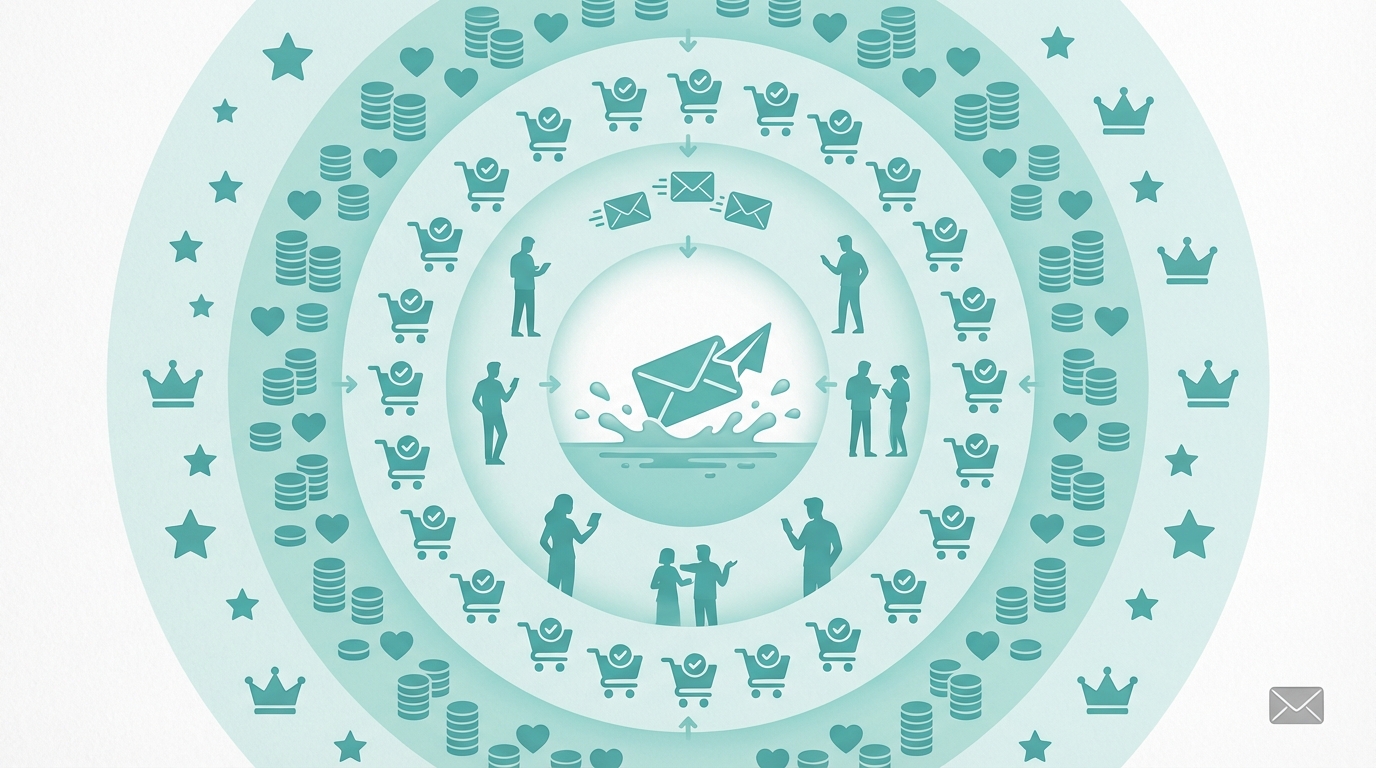 The numbers:
- Post-purchase emails achieve 40–50% open rates (vs. 15–20% for campaigns)
- Repeat customers spend 67% more than new customers
- Acquiring a new customer costs 5–25x more than retaining an existing one
- 32% of first-time buyers make a second purchase within the first year
Most brands send a single order confirmation and disappear until the next promotion. According to Klaviyo's ecommerce benchmarks, brands with strong post-purchase automation achieve 3x higher customer lifetime value than those without it.
The Psychology of the Post-Purchase Window
Buyer psychology operates in 4 distinct phases, each requiring a different email approach.
Day 1–2: Excitement Phase- Anticipating arrival
- Seeking validation for the purchase decision
- Absorbing additional product information
- Requiring shipping updates
- Building anticipation toward delivery
- Researching product usage methods
- Unboxing and forming first-use impressions
- Evaluating product quality
- Sharing the experience across 3+ social channels
- Deciding whether the product meets expectations
- Forming long-term loyalty impressions
- Responding to cross-sell offers at 62% higher acceptance rates when satisfied
Post-Purchase Sequence Workflow
Get our 4-email starter sequence for n8n. Includes order confirmation, delivery follow-up, review request, and cross-sell emails with automated timing. Customize templates for your brand.
Need the full AI-powered version? Talk to our team
The 7-Email Post-Purchase Sequence Framework
This 7-email framework increases customer retention by 31% and repeat purchase rates by 27% when deployed with precise timing and value-aligned content (Klaviyo 2025 Email Benchmark Report). Each email targets a specific psychological phase to maximize engagement and revenue per sequence.Email 1: Order Confirmation (Immediate)
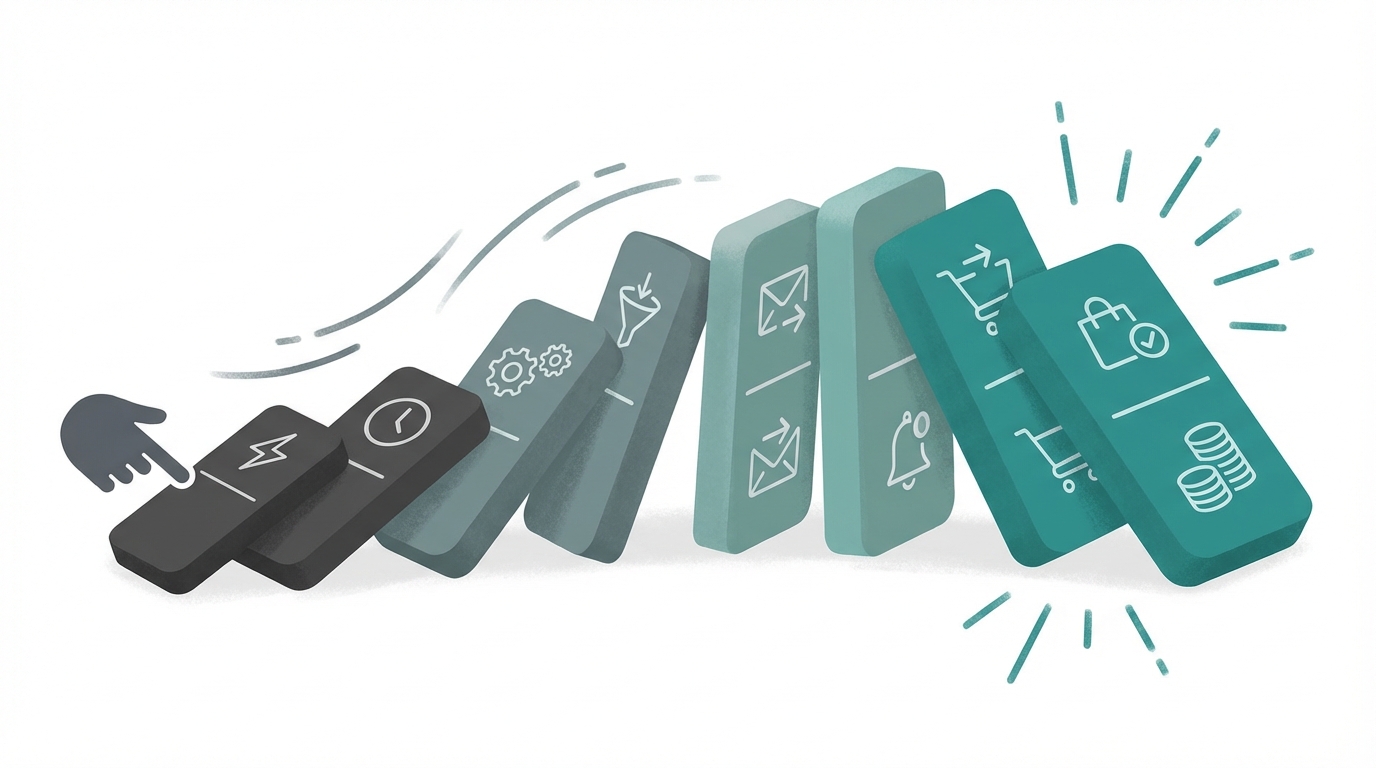 Purpose: Confirm the transaction and set expectations.
Essential elements:
Purpose: Confirm the transaction and set expectations.
Essential elements:
- Order number and details
- Payment confirmation
- Expected delivery timeline
- Customer support contact
- Include tracking link (even if "pending")
- Suggest related products
- Set expectations for upcoming emails
- Link to FAQ or preparation content
- "Order confirmed! Here's what's next"
- "Thanks for your order, [Name]!"
- "Your [Product] is on its way"
Email 2: Shipping Confirmation (When shipped)
Purpose: Build anticipation and reduce "where is it?" support tickets. Essential elements:- Tracking number and link
- Estimated delivery date
- Carrier information
- Product care/preparation tips
- What to expect on arrival
- Unboxing video or preview
- Community invitation
- "Your order just shipped!"
- "[Name], your [Product] is on the move"
- "Track your order + what to do when it arrives"
Email 3: Delivery Follow-up (Day after delivery)
Purpose: Check in and provide value at the peak excitement moment. Essential elements:- Delivery confirmation
- Getting started guide
- Support resources
- Quick start tips
- Video tutorials
- Common questions answered
- Feedback request (soft)
- "Did your [Product] arrive safely?"
- "Your [Product] has arrived—here's how to get started"
- "Package delivered! Need any help?"
Email 4: Education & Tips (Day 3–5 post-delivery)
Purpose: Help customers extract maximum value from their purchase. Essential elements:- Usage tips and best practices
- 3 common mistakes to avoid
- Strategies for getting the most from the product
- "5 ways to use your [Product]"
- "The mistake most people make with [Product]"
- Customer success stories
- Expert tips video
- "Getting the most from your [Product]"
- "3 tips you'll wish you knew sooner"
- "[Name], are you using it like this?"
Email 5: User-Generated Content (Day 7–10 post-delivery)
Purpose: Deepen engagement and gather social proof. Essential elements:- Invitation to share experience
- Instructions for tagging/sharing on social
- Community showcase
- UGC examples from 3–5 other customers
- Hashtag and sharing instructions
- Incentive for sharing (optional)
- Feature opportunity
- "Share your experience, get featured"
- "We'd love to see your [Product] in action"
- "Join 10,000+ customers sharing their results"
Email 6: Review Request (Day 10–14 post-delivery)
Purpose: Capture reviews for social proof and product feedback. Best practices:- Make it easy (1-click if possible)
- Explain why reviews matter
- Consider incentive (small discount on next order)
- Follow up if no response
- Consumables: Sooner (once used)
- Durables: Later (time to evaluate)
- Complex products: Later (learning curve)
- "Quick favor, [Name]?"
- "How's your [Product] working out?"
- "Leave a review, get [incentive]"
Email 7: Cross-sell/Replenishment (Day 14–30)
Purpose: Drive repeat purchase with a relevant, timed offer. For replenishables:- Time based on average usage cycle
- Offer subscription option via Recharge
- Bundle deals for restocking
- Complementary product suggestions
- Accessories and add-ons
- Upgrade opportunities
- "Ready for your refill?"
- "Customers who bought [Product] also loved..."
- "Complete your setup with [Accessory]"
Timing Optimization by Product Type
Product type determines optimal email timing — a skincare sequence requires 14-day review windows while a supplements sequence accelerates to 7–10 days (Klaviyo 2025 Email Benchmark Report).| Product Type | Email 4–5 | Email 6 | Email 7 |
|---|---|---|---|
| Skincare | Day 5–7 | Day 14 | Day 21–28 |
| Supplements | Day 3–5 | Day 7–10 | Day 21–25 |
| Apparel | Day 3–5 | Day 7–10 | Day 14–21 |
| Electronics | Day 5–7 | Day 14–21 | Day 30+ |
| Home goods | Day 3–5 | Day 7–14 | Day 21–30 |
Replenishment Timing Formula
The replenishment timing formula fires at 75% of the product's usable life — this catches customers before they run out, increasing replenishment conversion by 22% compared to end-of-cycle triggers.Replenishment Email = Purchase Date + (Product Life × 0.75)
Example: 30-day supply vitamin
Email timing = Purchase + (30 × 0.75) = Day 22-23
Templates and Examples
Education Email Template
Subject: 3 [Product] tips you'll wish you knew sooner
Hey [Name],
You've had your [Product] for a few days now—how's it going?
Most customers tell us they didn't know these tricks at first:
- [Tip 1 with brief explanation]
- [Tip 2 with brief explanation]
- [Tip 3 with brief explanation]
The difference these make is huge. [Customer name] told us:
"[Brief testimonial about using tips]"
Got questions? Just hit reply—we read every email.
[Signature]
P.S. [Bonus tip or resource link]
Review Request Template
Subject: Quick favor, [Name]?
Hey [Name],
You've had your [Product] for a couple of weeks now, and we'd love to hear how it's going.
Would you take 30 seconds to leave a review?
[Star rating buttons or review link]
Your feedback helps other shoppers make confident decisions—and helps us keep improving.
As a thank you, here's [incentive] for your next order: [Code]
Thanks for being a customer!
[Signature]
Cross-sell Template
Subject: Complete your [Product category] setup
Hey [Name],
Loving your [Original product]? Here's what other customers paired it with:
[Product 2] - [Brief benefit]
[Product 3] - [Brief benefit]
[Product 4] - [Brief benefit]
Use code [CODE] for [discount] off any of these.
[Shop now button]
Not sure what you need? Reply and I'll help you figure it out.
[Signature]
AI-Driven Post-Purchase Personalization
AI-powered personalization increases post-purchase email revenue by 38% compared to static template sequences sent at uniform intervals (Klaviyo 2025 Email Benchmark Report). Static templates sent at fixed times to every customer forfeit measurable revenue — tools like Klaviyo, Omnisend, and Attentive eliminate this gap through 3 core personalization capabilities.Send-Time Optimization
Send-time optimization in Klaviyo increases open rates by an average of 26% compared to fixed send times by predicting the individual moment each subscriber is most likely to engage. Klaviyo's Smart Send Time, Omnisend's Send Time Optimization, and Attentive's intelligent delivery windows all analyze historical engagement patterns per subscriber and distribute sends across a 24-hour window instead of batch-blasting. Implementation:- In Klaviyo: Enable Smart Send Time in Flow Settings > Timing
- In Omnisend: Use Send Time Optimization on flow triggers
- Segment sends across a 24-hour window instead of batch-blasting
AI-Generated Subject Lines
AI subject line testing tools improve post-purchase open rates by 18% by generating and A/B testing multiple variants at scale. The 4 highest-performing subject line formats for post-purchase emails are:| Intent | Formula | Example |
|---|---|---|
| Curiosity | "[Product]—are you doing this?" | "Your skincare routine—are you doing this?" |
| Urgency | "Your [Product] + one thing you need" | "Your vitamins + one thing you need" |
| Social | "[N] people do this with [Product]" | "8,000 people do this with their cleansers" |
| Value | "[Tip] most [Product] owners miss" | "The tip most supplement buyers miss" |
Dynamic Product Recommendations
AI-powered collaborative filtering converts at 8–15% — 4x higher than static cross-sell blocks ("customers also bought"), which convert at 2–4%. Klaviyo's AI Recommendations, Omnisend's activity-based Product Picker, and Yotpo's personalization engine surface products based on purchase patterns from customers with similar buying histories, updating recommendations in real time as new order data flows in. Setup in Klaviyo:- Add a Product Block to your cross-sell email
- Set the block type to "Related Products"
- Enable "AI-Powered Recommendations" (requires Klaviyo Plus or Ecommerce plan)
- The algorithm updates recommendations in real-time as new purchase data flows in
- Use Product Picker with "Based on customer activity" option
- Combine with purchase history segmentation for further precision
Predictive Replenishment Triggers
Predictive replenishment triggers convert at 18–25% — more than double the 8–12% conversion rate of fixed-day replenishment emails (Klaviyo 2025 Email Benchmark Report). Klaviyo's Predictive Analytics, Recharge's subscription propensity model, and Omnisend's purchase frequency analysis all calculate expected next-order date per customer by analyzing 3 data inputs:- Average consumption rate from prior purchase cohorts
- Individual order history (frequency, quantities)
- Seasonal patterns
The standard formula works as a baseline:
Replenishment trigger = Purchase date + (Product lifetime × 0.75)
Advanced Post-Purchase Email Tactics
Segmentation Strategies for Post-Purchase Emails
Behavioral segmentation increases post-purchase email revenue per recipient by 41% by delivering content matched to purchase context rather than broadcasting identical messages to all buyers. Segment using 4 primary dimensions in tools like Klaviyo, Omnisend, or Gorgias: Segment by:- First-time vs. repeat buyer
- Product category purchased
- Order value
- Geographic location
- First-timers need 3x more education content than repeat buyers
- High-value customers (top 20% by AOV) respond to VIP treatment sequences
- Product-specific tips generate 34% higher click rates than generic content
- Location determines shipping window accuracy, reducing WISMO tickets by 28%
A/B Testing Priorities
Test in order:- Subject lines (biggest impact)
- Sending time
- Email length
- CTA placement
- Incentive amounts
Conditional Logic
Smart sequences adapt:- Skip shipping email if local pickup
- Different timing for pre-orders
- Adjusted flow for subscription first shipment
- Review request timing based on product complexity
Measuring Success: KPIs That Matter
Post-Purchase Email Benchmarks
Revenue per email sent is the single most actionable post-purchase metric because it normalizes performance across list size, email count, and product category (Klaviyo 2025 Email Benchmark Report).| Metric | Industry Average | Strong Performance | Best-in-Class |
|---|---|---|---|
| Open rate | 40–50% | 55%+ | 65%+ |
| Click rate | 8–12% | 15%+ | 22%+ |
| Review conversion | 5–10% | 15%+ | 25%+ |
| Repeat purchase (30 day) | 8–12% | 15%+ | 25%+ |
| Revenue per email sent | $0.08–0.12 | $0.20+ | $0.40+ |
| Repeat Purchase Rate (RPR) | 25–30% | 35%+ | 45%+ |
Revenue Per Email (RPE)
RPE normalizes post-purchase flow performance across list size and email volume, making it the most reliable metric for comparing sequence variants or benchmarking against industry data.RPE = Total revenue attributed to flow ÷ Total emails sent
Example: $12,000 revenue from 50,000 emails sent = $0.24 RPE
Post-Purchase's Contribution to Customer LTV
Post-purchase sequences compound customer lifetime value across 3 measurable dimensions that most stores underreport (Bain & Company, Klaviyo 2025 Email Benchmark Report):- A customer completing a second purchase has a 27% higher LTV than a one-time buyer (Bain & Company)
- Customers engaging with Yotpo or Klaviyo post-purchase review requests show 40% higher 12-month retention
- Every 1% improvement in 90-day repeat purchase rate adds ~$35,000 annually to a store generating $3M/year in revenue
These 3 compounding effects explain why post-purchase automation consistently delivers the highest ROI of any email flow — outperforming welcome sequences, abandonment flows, and broadcast campaigns.
Attribution Tracking
Track which emails drive 4 measurable outcomes:
- Review submissions (compare Yotpo or Klaviyo review-request send rate vs. review volume)
- Repeat purchases (use UTM parameters on all CTA links)
- Referrals (track referral code redemptions via Postscript or Attentive)
- Support ticket reduction (compare Gorgias WISMO ticket volumes before/after shipping confirmation setup)
Next Steps: Automating Your Post-Purchase Sequence
- Book a strategy call to discuss your complete email automation strategy
- Build your welcome series: Read our Welcome Email Series guide
- Automate your email workflows: Explore our Revenue Recovery Engine for complete email automation
- Measure email performance: Check out our Email Revenue Attribution guide
- Learn from industry data: See Shopify's email marketing research